
28 Oct Elizabeth St.John The Queen’s Tears @ElizStJohn @cathiedunn @maryanneyarde
FEATURED AUTHOR: ELIZABETH ST.JOHN
I’m delighted to host Elizabeth St.John again as the featured author in the The Coffee Pot Book Club Blog being held between October 19th – 30th, 2026. Elizabeth St.John is the author of the Dual-Timeline Historical Fiction, The Queen’s Tears (A Julia Darke Novel), published by Falcon Historical Press on October 15, 2026 (400 pages).
Below are highlights of The Queen’s Tears, Elizabeth St.John’s author bio, and a guest post by the author about writing a dual timeline.
Tour Schedule Page: https://thecoffeepotbookclub.blogspot.com/2026/09/blog-tour-the-queens-tears-by-elizabeth-stjohn.html
HIGHLIGHTS: THE QUEEN’S TEARS
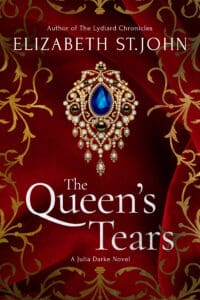
The Queen’s Tears
(A Julia Darke Novel)
by Elizabeth St.John
A stolen crown jewel and an enigmatic portrait force two women to confront the devastating choices they made for love—and summon the courage to live with the truth.
1619: Barbara, Lady Villiers, at the bidding of her brother-in-law, the Duke of Buckingham, has stolen the dying Queen Anna’s jewels—and kept the greatest prize for herself. The Queen’s Tears, a brooch of extraordinary value, torments her: too dangerous to sell, too priceless to discard, and possibly her only means of securing her children’s future. When the family fortunes are shattered, Barbara faces an impossible choice: remain loyal to Buckingham—or betray him by confessing the theft to King Charles.
Present Day: Julia Darke opens her Cotswolds bookshop to start life over peacefully. Instead, a Van Dyck portrait of Barbara’s daughter, with tantalising signs of the missing Queen’s Tears hidden in plain sight, brings her face-to-face with Oliver Villiers, the Oxford art conservator she once loved and walked away from.
Reluctantly drawn together to uncover Barbara’s secret, Julia and Oliver follow the trail of the Queen’s Tears—and the closer Julia comes to Barbara’s truth, the harder it becomes to hide from her own.
Inspired by the true stories of Queen Anna of Denmark’s stolen jewels and a missing Van Dyck painting, The Queen’s Tears weaves history, fiction, and family research across the centuries. Readers of The Lydiard Chronicles will find old favourites—and a new heroine following in their footsteps.
Buy Link:
Universal Buy Link: https://geni.us/TheQueensTears
This title is available to read on #KindleUnlimited.
AUTHOR BIO: ELIZABETH ST.JOHN
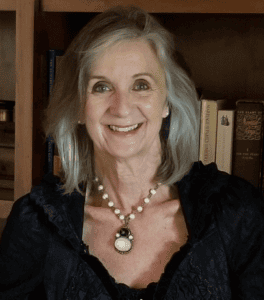
Elizabeth St.John’s acclaimed historical fiction brings to life her ancestors—remarkable women linked to England’s royalty—offering unique insights into Medieval, Tudor, and Stuart times. Her novels unfold not just as traditional series, but as an interlocking web of lives: The Lydiard Chronicles—including the celebrated The Lady of the Tower—The Godmother’s Secret, and The King’s Intelligencer explore everything from the English Civil War to the mystery of the Princes in the Tower. Her newest novel, The Queen’s Tears, a dual timeline pursuing a stolen crown jewel, reunites favourite characters from the seventeenth-century with a present-day bookstore owner heroine.
At the heart of her writing is the transformation of real ancestral histories into narratives of historical continuity. She follows threads of legacy through generations, guided as much by wills, letters, portraits, country churches, ruined castles, manor houses, and lost gardens as by imagination. Locations become constant companions through time, while characters whisper across centuries—their decisions resonating in the lives of their descendants to reveal how choices shape legacies. Grounded in historic sites like Lydiard Park and the Tower of London, her work creates a living archival flow that continues to flourish as the past yields its secrets.
Elizabeth divides her time between California, England, and the past, surrounded by books, gardens, and animals, with a slightly bewildered, ever-supportive husband beside her.
Author Links:
Website Twitter / X Facebook Instagram Bluesky
Book Bub Threads Amazon Author Page Goodreads Linked In
GUEST POST: WRITING A DUAL TIMELINE
Two Women, Four Centuries and a lot of Running Back and Forth
Writing my first dual timeline
Most authors get itchy feet at some point, and after years of writing from the Lydiard family archives, sticking as close to the record as I possibly could with the lives of real women, I found I was ready for something different. I had played with the idea of writing my previous novel, The King’s Intelligencer, as a dual timeline, but the story quickly bloomed into something too sweeping to split in to. But the challenge of a dual timeline didn’t go away, and The Queen’s Tears gave me the perfect excuse to have a go, although I had no real idea how to tackle it, or where the challenges would be.
The lure of writing two sixty-thousand-word stories rather than one long one was an interesting start. A novel has about the same number of words whether it tells one story or two, so each of mine had to make do with half of what I’m used to. That meant squeezing Barbara’s decades at a court full of schemers into half a book, while Julia’s secrets and her long overdue reunion had to fit into the other half. My first draft was actually short on words, because I really tried to edit as a I wrote to justify the scenes not only for the main story, but to reflect in the companion. Wrong. I quickly knocked down those guardrails and some of the best scenes and subplots emerged, with room to spare.
Many of the dual timelines I’ve read have ended up with me favouring one era or protagonist over the other. I really wanted The Queen’s Tears to be balanced, and my readers to care equally about two women who just happened to live four hundred years apart. Their worlds may be different (although whispers of Barbara’s weave through Julia’s) and on the surface they have little in common. But once they were on the page, their characters provided the nuances where I could bring them together.
I’ve always said that no matter what, people change far less than the circumstances around them, and that whatever hurt in 1619 would hurt exactly the same today. Of course, fear and courage look different across the centuries, but finding the mettle to meet obstacles head on is an inner strength. Barbara may have to navigate perils of betrayal within the King’s court, or disease in a distant land, and Julia’s troubles are quieter, returning to face what she walked away from. But both are impacted by their losses, carries that emptiness around for years, and yet both go on loving, even when it costs them dearly. This turns out to be the thing they have most in common.
And then I realised that although their lives were lived in a straight timeline, feelings and emotions could curl like woodsmoke over the years and relationships could echo and reflect without structure. Suddenly I wasn’t telling two different stories, I was catching the essence of their life experiences and drawing them together.
Once I let go of a straight-line narrative, the structure started working with me rather than against me. I looked for echoes and mirrors between the stories, so that a decision made in the past casts its shadow over whatever Julia finds in the present, and the reader senses the link a little before the characters do. Julia begins to understand Barbara through what she left behind, and discovers somewhat to her surprise that she is understanding herself as well.
I wanted my readers to pick up my book, meet someone from a very long way off who turns out to feel just as we do, and to welcome the present-day character as someone they would want to spend time with. Most of all, I wanted two women who could look at each other across four hundred years and say they understood each other. Whether I managed it is for you to decide, but I certainly enjoyed myself trying.
X/Twitter: @cathiedunn @maryanneyarde
Instagram: @thecoffeepotbookclub @yardereviews






No Comments