
02 Jul Elisabeth Storrs Fables & Lies #HistoricalFiction #WW2Fiction #enemiestolovers #darkfamilysecrets #undercoveragent #truestory #BlogTour #TheCoffeePotBookClub @elisabethstorrs @cathiedunn
FEATURED AUTHOR: ELISABETH STORRS
It’s my pleasure to welcome Elisabeth Storrs as the featured author in The Coffee Pot Book Club Blog Tour being held between June 12th – July 3rd, 2026. Elisabeth Storrs is the author of the Historical Fiction, Fables & Lies: A World War II Novel Based on a True Story, published by The Book Guild (Digital and Paperback) and Bolinda Audio (Audio) on 28th April 2026 (584 pages).
Below are highlights of Fables & Lies, the author bio of Elisabeth Storrs, and a guest post about the Pre and Early History Museum in the “Martin Gropius Bau” building at Prinz-Albrect-Strasse, which has the distinction of being located next to the Gestapo Headquarters.
Tour Schedule Page: https://thecoffeepotbookclub.blogspot.com/2026/05/blog-tour-fables-and-lies-by-elisabeth-storrs.html
HIGHLIGHTS: FABLES AND LIES
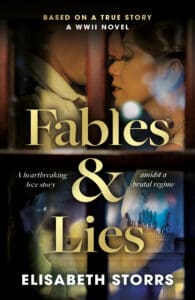
Fables & Lies: A World War II Novel Based on a True Story
Author: Elisabeth Storrs
Audiobook Narrator: Lucy Tregear
Blurb:
Under a brutal regime, what price must be paid to preserve truth, treasure and love in a world built on lies?
WWII Berlin. Freyja Bremer, a patriotic museum assistant, marries Kaspar Voigt, an ambitious SS scholar, to protect her father. Yet she is unaware her husband is instrumental in Himmler’s twisted quest for Aryan supremacy.
As she strives to safeguard the priceless Priam’s Treasure from air raids, Freyja falls in love with Darien Lessing, an archaeologist who exposes the moral decay beneath the Regime’s myths. Her awakening drives her into perilous resistance — aiding a Jewish doctor and his wife, Darien’s sister — while uncovering Kaspar’s role in the SS’s darkest programs, which subvert history to justify invasion, abduction and murder.
As Berlin collapses into chaos and bloodshed, Freyja, caught between duty, deception and desire, must risk everything to preserve truth in a world built on lies.
A heartbreaking yet triumphant love story, Fables & Lies shines light on lesser-known aspects of the Nazi Regime. It gives voice to the complex moral struggles of German women, the forgotten resistance of Gentiles married to Jews, the dangers of contested history, the evils of Himmler’s racial studies program and the unsung bravery of German museum curators who saved their nation’s treasures.
Perfect for readers of Kelly Rimmer, Anthony Doer and Laura Morelli.
Praise for Fables & Lies:
“A heartrending story of a young woman caught in the machinations of the Third Reich and in the web of a regime-compliant family. The novel is meticulously researched and emotionally resonant, sure to delight readers who love a hearty feast of history in their fiction.” ~ Olivia Hawker, bestselling author of The Ragged Edge of Night
“A powerful and heartbreaking story set in war-torn Berlin, FABLES & LIES charts the slow dawning horror of a young woman as she realises all she has been taught about Hitler and the Third Reich is a lie. Impeccably researched and sensitively rendered, Elisabeth Storrs has shone a light on little-known aspects of life in Germany under the Nazi regime.”~ Kate Forsyth, bestselling author of Bitter Greens
“Written from the little explored German viewpoint, FABLES & LIES is a gripping account of the quest to save the world’s great antiquities during WW2 and an ode to those women and men who risked all for freedom. A beautifully written novel. I’ve never read anything like it.”~ Nicole Alexander, author of The Limestone Road
“Elisabeth Storrs has indeed broken the mould by writing ‘from the other side’. Evocative, detailed and heart-rending as the heroine journeys through disillusion and danger in the Third Reich.”~ Alison Morton, author of the Roma Nova series
“A chilling and meticulously researched journey into the shadow world of the Ahnenerbe. Blending historical rigor with gripping fiction, FABLES & LIES reminds us of the devastating consequences when history is twisted to serve power.”~ Leah Kaminsky, author of The Hollow Bones
Any Triggers: The book contains offensive Nazi ideology together with graphic war imagery (including rape), still birth, and bereavement.
Buy Link:
Universal Buy Link: https://books2read.com/fablesandlies
* Goodreads Giveaway *
https://www.goodreads.com/giveaway/show/442105-fables-lies-a-wwii-novel-based-on-a-true-story
AUTHOR BIO: ELISABETH STORRS
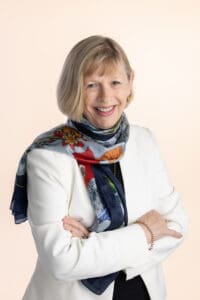
Elisabeth Storrs has a great love for history and myths. She is the award-winning author of A Tale of Ancient Rome trilogy which was endorsed by Ursula Le Guin, Kate Quinn and Ben Kane.
Now her obsession lies with Trojan treasure and twisted Germanic prehistory in her new release, Fables & Lies: A World War II Novel.
Elisabeth is also the founder of the Historical Novel Society Australasia and the $155,000 ARA Historical Novel Prize. She lives in Sydney with her husband in a house surrounded by jacarandas.
Author Links:
Website Twitter / X Instagram Facebook Pinterest
Book Bub TikTok Amazon Author Page Goodreads
GUEST POST: THE MUSEUM AT PRINZ-ALBRECT-STRASSE
BY ELISABETH STORRS
Thanks for featuring my new novel. Fables & Lies: A World War II Novel arose from my fascination with the archaeologist, Heinrich Schliemann, who not only proved the ancient city of Troy existed but also discovered a fabulous cache of gold there known as “Priam’s Treasure”. Schliemann smuggled the trove out of Turkey then “bequeathed” it to the German people. During WWII, the treasure was kept in a Berlin museum. After the Soviets looted the city, Priam’s Treasure disappeared mysteriously for 50 years until the Russians admitted they had hidden it in the Moscow’s Pushkin Museum where you can see it today.
My protagonist, Freyja Bremer, is a patriotic museum assistant raised on Nazi dogma. Through her love affair with Cambridge educated archaeologist, Darien Lessing, her eyes are opened to the rot beneath the Regime’s lies, as they both strive to protect Priam’s Treasure and other antiquities from air raids. Intertwined is Freyja’s forced marriage to Kaspar Voigt, one of Himmler’s SS racial studies scholars, and her quest to discover what her husband’s twisted research entails. As such, Freyja’s safekeeping efforts and her journey to enlightenment form the spine of the novel. However, I also explore Himmler’s promulgation of the “Aryan Myth” to justify invasion, dispossession and murder.
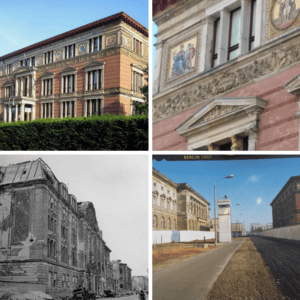
When “walking the ground” in Berlin, my research revealed Priam’s Treasure was housed in the Pre and Early History Museum in the “Martin Gropius Bau” building on Prinz-Albrecht-Strasse (now Niederkirchnerstrasse). It had the distinction of being located next to Gestapo Headquarters which intrigued me.
In the late 1880s, the short street boasted the elegant Prince Albrecht Palais at No. 9 and Martin Gropius Bau at No.7 which was purpose built in 1881 to house the Museum of Decorative Arts. In 1905, an extension to the Decorative Arts Museum was built at No.8. Later this annexe became the School of Industrial Arts.
After WWI, the Museum of Decorative Arts was moved elsewhere in Berlin. Martin Gropius Bau became known as “the Museum at Prinz-Albrecht-Strasse” which housed three collections – Pre and Early History, East Asian and the Art History Library. The “Schliemann Salon” boasted Priam’s Treasure and other Trojan exhibits. The “Gold Hall” was filled with magnificent Merovingian Frankish jewellery and Bronze Age troves such as the Cottbus and Eberswalde Hoards. In all, there were over 100,000 exhibits in the Pre and Early History Museum alone.
Martin Gropius Bau Outside
The tenor of Prinz-Albrecht-Strasse street changed after 1933. No.8 was taken over as Gestapo Headquarters. The palace at No.9, since turned into a Grand Hotel, became SS House. Being taken “to No.8” was a terrifying prospect. Dungeons were built underground. A “House Prison” was erected in its grounds. Thousands of people were interrogated and tortured within its walls.
Of course, Gestapo HQ and other Wilhelmstrasse ministries became targets for Allied bombers during the war. As a result, Martin Gropius Bau was under constant threat of becoming collateral damage. Despite this danger, curators persisted in packing their exhibits until the museum was finally destroyed in February 1945. Freyja risks her life packing the collections while watching the museum take hit after hit. She lives in a world of oppression where trust is a fragile currency. Threats from the Gestapo loom large in her life as much as the HQ’s physical presence next to her workplace. As Himmler made it a prerequisite for SS cadets to pass an exam on pre-history she grows used to “Black Angels” attending lectures in the museum. There is no escaping interaction with her sinister neighbours.
Niederkirchnerstrasse stands today as a time capsule for various eras in Berlin’s history. No.8 and No.9 have been razed with only the basement cells remaining. A museum known as “The Topography of Terrors” has been established to serve as a reminder of the oppression of the Regime. The street also holds echoes of the misery of the German Democratic Republic. The Berlin Wall ran down the middle of the road cutting off Mitte in the east from Kreuzberg in the west. Martin Gropius Bau ended up in the “American sector”’ during the period of the Four Powers. Checkpoint Charlie, the infamous crossing point featured so often in spy thrillers, was located nearby. A section of the wall with its death strip remains as a memorial.
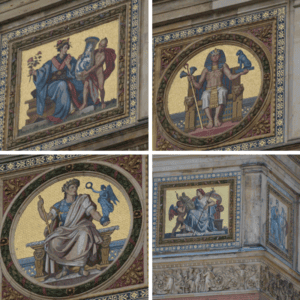
Next to this wasteland, Martin Gropius Bau rises in its splendour. The West Germans reconstructed it in 1978 with further renovations occurring after reunification. It certainly wasn’t what I expected to find on my tour – a delight to behold – one of the most beautiful historic buildings in Berlin. On its top floor is a row of Venetian majolica mosaics depicting nine different epochs of art exemplified by figures such as an Egyptian pharaoh, Japanese geisha and Roman Caesar and Grecian noblewoman. In addition to these magnificent friezes, each storey is demarked by terracotta reliefs portraying industrious craftsmen such as glass blowers, masons and carpenters.
Martin Gropius Bau Mosaics
Inside, the museum is no less wondrous. The rococo décor is a celebration of the Baroque with green acanthus balustrades and stucco ceilings festooned with garlands. In the foyer is a beautiful leadlight dome. Three double doors lead to a huge atrium covered by a rectangular skylight. In its heyday, over thirty exhibition salons surrounded the hall on the ground and first floors. Now it is an art exhibition space which has featured artists such as Wei Wei, Anish Kapoor and Paul Klee.
I admit that I’ve become entranced by this amazing building with all its layers of history. If you are ever in Berlin – I recommend you visit. You won’t be disappointed!
All images are courtesy Wikimedia commons.
Twitter: @cathiedunn
Instagram & Threads: @thecoffeepotbookclub
Bluesky: @cathiedunn.bsky.social






Elisabeth Storrs
Posted at 01:00h, 03 JulyThanks so much for featuring my guest post, Linnea – much appreciated!
Linnea Tanner
Posted at 00:13h, 07 JulyHi Elisabeth–It was a pleasure to host you and feature your compelling novel, “Fables & Lies”. Your background information on the Museum at Prinz-Albrect-Strasse was fascinating. Best wishes on the book.
Elisabeth Storrs
Posted at 01:21h, 04 JulyThanks so much for hosting me. I hope your readers enjoy my post!
Linnea Tanner
Posted at 00:01h, 07 JulyHi Elisabeth–It was a pleasure to feature you and your novel, “Fables & Lies,” set in World War II. Your post about the Museum in the “Martin Gropius Bau” building at Prinz-Albrect-Strasse was fascinating. It was interesting to learn that archaeologist, Heinrich Schliemann, who not only proved the ancient city of Troy existed but also smuggled a cache of gold known as “Priam’s Treasure” out of Turkey then “bequeathed” it to the German people. Best wishes on the novel.