
29 Jun Helena P. Schrader Voices on the Wind #WWII #HistoricalFiction #AviationHistory #Malta #BlogTour #Yarde Book Promotions @maryanneyarde
FEATURED AUTHOR: HELENA P. SCHRADER
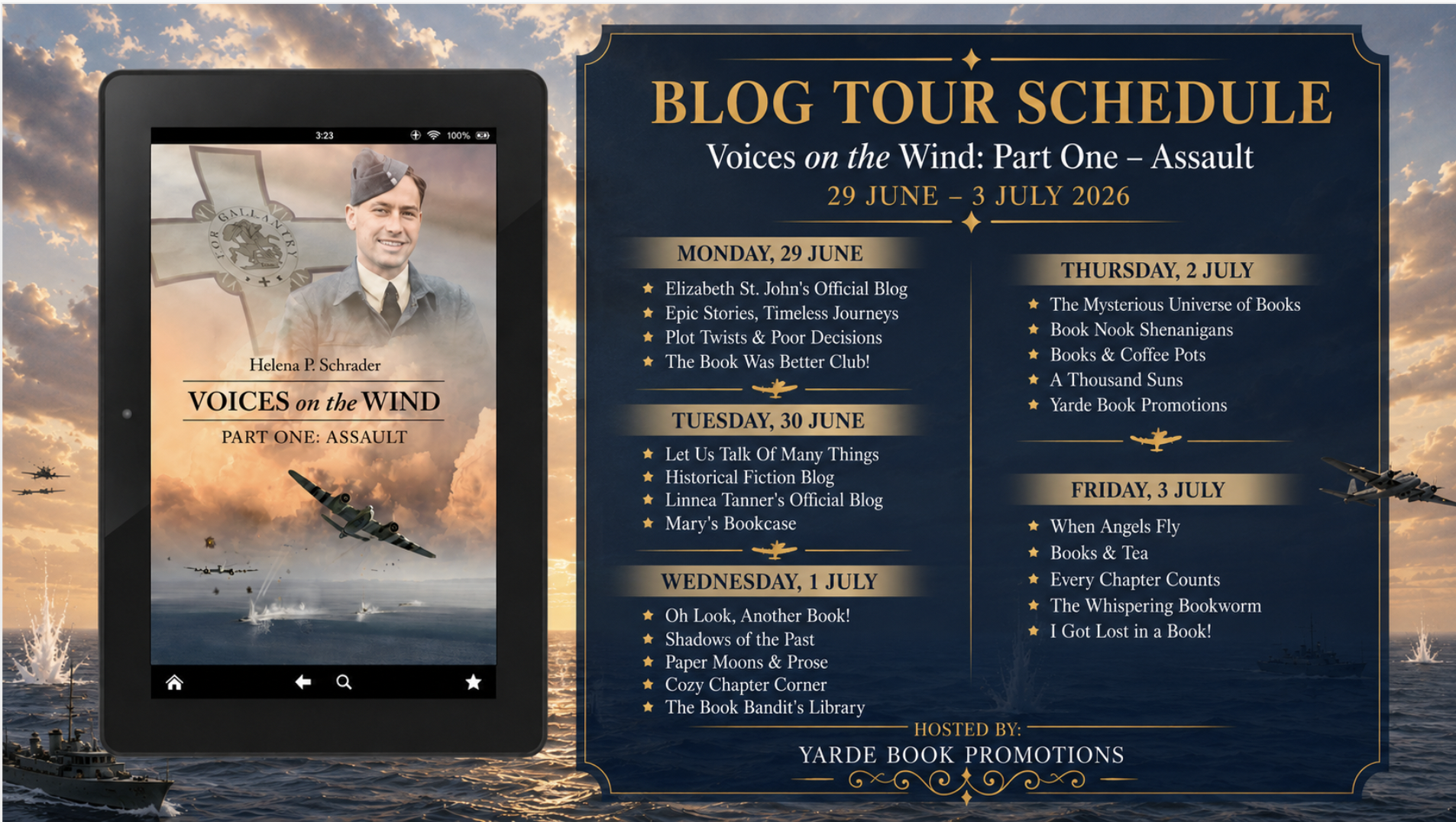
I’m delighted to welcome Helena P. Schrader as the featured author in the Yarde Book Promotions Blog Tour being held between June 29th – 3rd July 2026. Helena P. Schrader is the author of the Historical Fiction, Voices on the Wind (A Novel of Malta in WWII, Part I — Assault), published by Cross Seas Press on June 11th, 2026 (448 pages).
Below are highlights of Voices on the Wind, Helena P. Schrader’s author bio, and an excerpt of the novel.
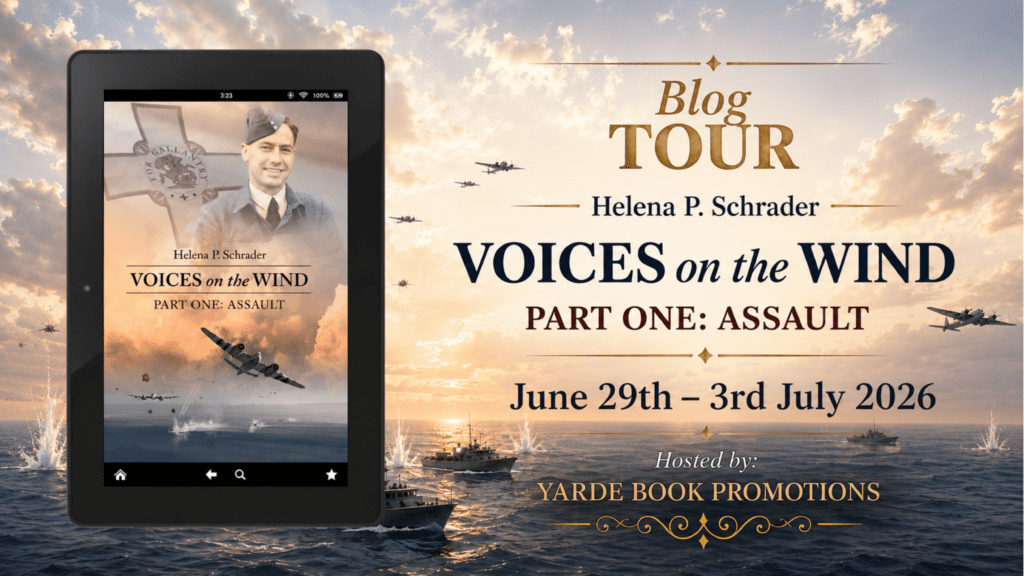
Tour Schedule Page: https://maryanneyarde.blogspot.com/2026/06/blog-tour-voices-on-wind-novel-of-malta.html
HIGHLIGHTS: VOICES ON THE WIND
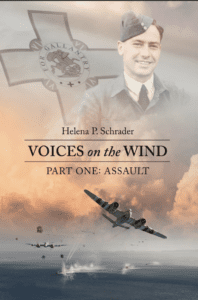
Voices on the Wind
(A Novel of Malta in WWII, Part I — Assault)
By Helena P. Schrader
Blurb:
Early 1942: the fate of the Suez Canal and access to Middle East oil hangs on the fate of an island just 17 miles long by 9 miles wide: Malta.
Determined to destroy the British forces threatening Rommel’s supply lines, the Axis powers drop more bombs on Malta than London endured throughout the Blitz. The population is forced underground, while the RAF struggles with inadequate resources to fend off defeat. Meanwhile, Britain’s Atlantic lifeline is fraying….
Voices on the Wind follows the fate of four of Malta’s defenders: Senior Intelligence Officer and former Battle of Britain ace, W/Cdr “Robin” Priestman; WAAF SigInt Officer Candice Weld, sent out from Bletchley Park to “man” the only X-machine outside the UK; F/O “Ned” Nettleton, a Beaufort torpedo bomber pilot engaged in suicidal attacks against enemy shipping; and Chief Officer Stevie Mackay of the British Merchant Navy, fighting to keep Britain’s own lines of supply open.
Triggers: June 11 is the 81st anniversary of the first air raid on Malta in WWII.
Praise:
What emerges from these pages is more than a story of military operations. It is a portrait of service, endurance, and sacrifice viewed through multiple perspectives, each contributing to a richer understanding of a critical moment in history. — Yarde Book Promotions
Through a collective of narrators working in different areas of the war effort, mainly in and around Malta, “Voices on the Wind” by Helena P. Schrader explores a frequently overlooked aspect of history, delving into the defence of Malta during the Second World War. — The Coffee Pot Book Club
Buy Link:
Universal Buy Link: https://books2read.com/u/4DegDe
AUTHOR BIO: HELENA P. SCHRADER

Helena P. Schrader is the author of 21 historical novels and six non-fiction history books. She earned a PhD in History from the University of Hamburg and served as a U.S. diplomat in Europe and Africa. She has won numerous literary awards, and two of her titles—Cold Peace, the first book in the Bridge to Tomorrow series on the Berlin Airlift, and her Battle of Britain novel, Where Eagles Never Flew—achieved Amazon #1 Bestseller status in aviation and military historical fiction.
Schrader masterfully blends meticulous historical research with compelling storytelling. Her success can best be measured not by the many awards or positive reviews, but by the fact that witnesses of the history she describes praise the authenticity of her works. Battle of Britain ace, W/Cdr Bob Doe enthusiastically declared that Where Eagles Never Flew got it “smack on the way it was for us fighter pilots.” Traitors for the Sake of Humanity: A Novel of the German Resistance won recognition for its extraordinary sensitivity to a complex topic from the survivors of the military conspiracy against Hitler and the widows of some of those executed.
The dramatic siege of Malta in WWII attracted Schrader’s attention years ago, and she has visited the island several times to conduct research, visit the important sites, and gain a greater understanding of the people. As she became drawn deeper into the material, the temptation to combine a novel about the siege of Malta with another of her lifelong loves, the British Merchant Navy, became irresistible. Schrader has been an avid sailor all her life and served as a petty officer in the British Merchant Navy on sail training ships in her youth.
Social Media Links:
Website Facebook Bluesky Quora
Substack BookBub Goodreads Amazon Author Page
EXCERPT: VOICES ON THE WIND
Candice, Reporting for Duty
Context: WAAF Officer Candice Weld arrived in Malta aboard a Beaufort Torpedo bomber which must makes a forced landing after being attacked by Messerschmitts. Candice is injured and spends nearly two weeks in hospital before reporting for duty, her face is still bruised, swollen and misshapen.
Candice found herself in a warren of underground chambers. Lights hanging from thick cables on the ceiling lit the echoing corridors connecting them. Carved directly from limestone, these man-made caverns dripped moisture like the inside of a cave and were disagreeably noisy. The ventilators hummed constantly, the generators growled uninterrupted, and above these steady background sounds, voices, the clack of typewriters and the ringing of telephones competed for attention. This was not a pleasant environment, but it was a familiar one; many of Britain’s military nerve centres looked, sounded and smelled like this.
Eventually, after being directed down two flights of stairs, Candice arrived at a door marked “Joint Intelligence Centre.” She automatically squared her shoulders, lifted her chin and drew a deep breath in preparation for meeting her new CO. She knocked firmly. A male voice called “Come in!”
Candice entered an anteroom with three doors leading off from the small, square office: one read “Army Branch,” one “Air Force Branch” and the third simply “Director.” Typical Senior Service, Candice thought, the Navy didn’t need to say who they were, they were simply in charge. Metal filing cabinets were squeezed in the corners, one with a tiny rotating fan on it. In the centre of the anteroom was a heavy wooden desk with a telephone on it, in- and out-trays, log books, and other paraphernalia. Behind the desk sat a RN Chief Petty Officer. He got to his feet at the sight of Candice’s uniform and stood stiffly as he asked, “How can I help you, Ma’am?”
“I’m the new Signals Officer,” Candice answered. “I’m here to report to the Director of Joint Military Intelligence, Malta.”
The Chief Petty Officer eyed her with open scepticism (or was he just leering at her badly bruised and still swollen face?) Only after an awkward pause did he ask, “Did you say Signals Officer, Ma’am?”
“Yes,” Candice insisted.
“I think there must be some sort of mistake,” he told her. “Wait one moment while I report to the Captain.” With this he turned to the door marked “Director” and knocked. Receiving a growl, he entered but didn’t bothering to close the door behind him. She could clearly hear him say, “There’s a little Waaf here, sir, calling herself a Signals Officer.” He ended this announcement with an audible chuckle.
“This is no laughing matter, Chief,” an older man’s voice admonished. “Women don’t belong in intelligence. They can’t keep their mouths shut! Send the silly girl in, and I’ll sort her out!”
Well, at least she was forewarned, Candice thought, resentfully. Then again, what had she expected of the Navy? Fortunately, her direct superior would be RAF.
The Chief Petty Officer stood back, holding the door for her. With a condescending smile he told her, “Captain Bancroft will see you now, Ma’am.”
Candice nodded her thanks and entered the lion’s den at internal ‘action stations.’ She drew up smartly, stamping her foot just a little to emphasise she had come to a complete halt. She raised her right hand in a smart salute — only to realise a second too late that the Captain seated opposite her was not wearing his cap. He could not return the salute and looked very sour about it. She hastily reached up and swept her cap off her head and stuffed it under her arm. “Sorry, sir,” she mumbled, as she felt the blood rush to her head. She was making a fool of herself at the worst possible moment.
The Captain’s expression, however, had altered from annoyed to shocked, “Good gracious, woman! What happened to your face?”
“The aircraft in which I flew to Malta had to make an emergency landing while the airfield was under attack. I was hit by some stone fragments when running for shelter. That’s why I’ve been in hospital for 12 days and was unable to report earlier.”
“Very nasty, indeed,” he assessed, considering the wound so closely that Candice wanted to cover it with her hand. She resisted the temptation and stood stiffly waiting for him to move on. Instead, he took on a fatherly tone and lamented, “Oh dear, oh dear! I do hope that will heal well. We wouldn’t want you to have a problem finding a husband, would we? How old are you anyway?” Not giving her a chance to reply, he continued in a disapproving tone, “It only goes to prove what I’ve always said: women have no business anywhere near the front lines. I cannot understand why The Powers that Be cannot grasp this simple fact. But here we are. I’m so sorry for you, my dear, but I’m sure we can set things right.” Then he cleared his throat and continued in his patronising tone, “Now, I’m told you are calling yourself a ‘Signals Officer,’ dear, but I presume what you mean is ‘Code and Cipher Officer’?”
“No, sir,” Candice corrected him politely but firmly. “Here are my orders.” She took her orders out of her left breast pocket and handed them over.
Captain Bancroft took the envelope, extracted the orders themselves and read them through thoroughly, his eyebrows lifting eloquently. Candice knew them by heart, and she could see that Captain Bancroft didn’t like what he saw. At length he folded the orders, replaced them in the envelope and handed them back to her. Dropping all pretence of being a ‘kindly uncle’ he addressed her in a clipped, professional tone while pointedly avoiding use of her rank, “Miss Weld, while your orders appear valid, I believe they are nevertheless in error. Whoever cut those orders was either blithely irresponsible or criminally stupid. Malta is the most bombed place on earth at the moment, and it is a hub of signals intelligence. We need a first-rate Signals Officer. We don’t have time for public relations stunts or whatever this is.”
Candice had spent two years steadily working her way up into this position. Some of the top people in the country had encouraged her to volunteer for the job, and she had nearly been killed getting here. She was not going to let herself be dismissed by mere prejudice. “With all due respect, sir, you have absolutely no knowledge of my qualifications, experience or suitability for this position. On the other hand, the Air Ministry Directorate for Postings, which is in a position to make that assessment, found me qualified for this assignment.”
Captain Bancroft pressed his lips firmly together, and his eyes narrowed. Stiffly, he acknowledged, “Without further comment on the competence of the junior service, I concede that since the Air Ministry made the mistake of sending you out here, the Head of the Air Branch must rectify the situation by seeing that you are transferred out as soon as possible — which I assure you, is very much in your own interests. You’ll have far better care for your facial injuries back in Britain, and you will be out of danger. Unfortunately, the Head of the Air Branch, Wing Commander Oliver, was killed at the same time as your predecessor when they went to visit one of the Y-stations on the coast. On the way, they were strafed by a German fighter and while taking evasive action, their vehicle went into a ditch. It rolled over three or four times, killing the driver and both passengers.”
Candice murmured, “That’s terrible, sir. I’m very sorry to hear it.”
“Yes, well, I’ve been informed that the new Head, Wing Commander Priestman, is due to arrive shortly. He’ll see that everything gets straightened out and you are sent to safety at the earliest opportunity. Meanwhile, I suggest you take care of yourself. Give that face more time to heal. You’ll be notified as soon as Priestman arrives. I’m very sorry for this whole unfortunate situation, but it is really for the best if you go back to Blighty and let us get on with the business of winning this war.” He stood and held out his hand.
The dismissal was too emphatic and comprehensive to leave any room for argument. Candice felt as if she had just been blown out of the water by a full broadside from a battleship. It left her devastated and defenceless. Years of discipline enabled her to draw herself up to attention and reply, “Very good, sir,” and then shake the offered hand. Then she exited with her head high and her back straight.
Inside, however, she felt like something that had washed up with the tide and needed to be ‘disposed of.’ She was not going to be given a chance to prove herself, and all the confidence placed in her back at Bletchley Park had been misplaced. She was going to be sent home with her tail between her legs, vindicating her father’s doubts about her abilities and utility in war. It was a humiliating defeat that she felt she would never live down.

Twitter / X Handle: @maryanneyarde
Instagram Handle: @yardereviews
Bluesky Handle: @maryanneyarde.bsky.social






Mary Anne Yarde
Posted at 04:31h, 30 JuneMany thanks for featuring Voices on the Wind today! We’re incredibly grateful for your support and hope your readers enjoy learning more about Helena P. Schrader’s compelling story of the Siege of Malta.
Linnea Tanner
Posted at 23:17h, 01 JulyHi Mary Anne–It was a pleasure to feature Helena P. Schrader and to highlight her novel, “Voices on the Wind,” about the Siege of Malta.
Helena P Schrader
Posted at 06:27h, 30 JuneThank you, Linnea, for hosting “Voices on the Wind” and including an excerpt! I really appreciate it! Helena
Linnea Tanner
Posted at 23:16h, 01 JulyHi Helena–It was my pleasure to feature “Voices on the Wind,” and highlight an excerpt about the compelling story of the Siege of Malta. Best wishes on this book.