

01 Apr David Loux The Lost Seigneur #HistoricalFiction #TheLostSeigneur #BlogTour #TheCoffeePotBookClub @ChateauLaux @cathiedunn
FEATURED AUTHOR: DAVID LOUX
It’s my pleasure to welcome David Loux as the featured author in The Coffee Pot Book Club Blog Tour being held between March 26th – April 16th, 2026. David Loux is the author of the Historical Fiction / Literary Fiction, The Lost Seigneur (A Chateau Laux Odyssey, Book #2), published by Wire Gate Press on October 7, 2025 (226 pages).
Below are highlights of The Lost Seigneur, David Loux’s author bio, and a guest post on his research related to the novel.
Tour Schedule Page: https://thecoffeepotbookclub.blogspot.com/2026/03/blog-tour-the-lost-seigneur-by-david-loux.html
HIGHLIGHTS: THE LOST SEIGNEUR
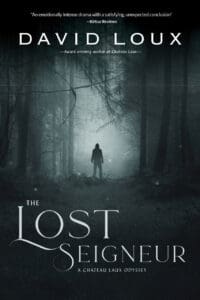 The Lost Seigneur
(A Chateau Laux Odyssey, Book #2)
by David Loux
Blurb:
The Lost Seigneur is a sequel to the award-winning Chateau Laux.
It is the story of Jean-Pierre du Laux, a nobleman in southern France, who was wrongly imprisoned during a time of religious intolerance and subsequently endeavors to return to his family. Many years have passed since he saw them, and his long incarceration has broken his health.
Any reunion would clearly have been impossible, without the unlikely help of a youthful companion that he meets along the way.
Any Triggers: The book contains imprisonment and non-graphic sex.
Buy Links:
Ebook Universal link: https://books2read.com/u/4DMa0k
Paperback universal link: https://mybook.to/The-Lost-Seigneur
AUTHOR BIO: DAVID LOUX

David Loux is the author of Chateau Laux, a critically acclaimed, award-winning novel that tells the story of a shocking incident in eighteenth century America. His second novel, The Lost Seigneur expands on the themes detailed in Chateau Laux. and completes the story of a French family’s migration to America in the eighteenth century.
He lives in the Eastern Sierra with his wife, Lynn.
Author Links:
Website: https://www.wiregatepress.com
Twitter / X: https://x.com/@ChateauLaux
Instagram: https://www.instagram.com/davidlouxauthor
Book Bub: https://www.bookbub.com/authors/david-loux
Amazon Author Page: https://www.amazon.com/author/davidloux
Goodreads: https://www.goodreads.com/author/show/20987947.David_Loux
GUEST POST: RESEARCH RELATED TO THE LOST SEIGNEUR
My research related to The Lost Seigneur began long before I had any intention of writing a novel. I was asked to do a presentation at a Laux family reunion that celebrated three hundred years in the United States. At the time, there was conflicting information and considerable debate concerning the origin of the surname. The name was so old that there were several variations of spelling and pronunciation, which added to the confusion, and I decided to tackle this topic in my presentation.
My research began with known genealogies, and a publication in 1910 was particularly helpful. This publication provided leads that took me to southern France, where I met distant relatives who provided new information on the topic. Operating under the hypothesis that name origins are intertwined with historical context, I cast a wide net, seeking any information that I could find regarding the time and place of the name’s emergence. When I discovered that the first known carrier of the Laux name was part Basque, I went to the Center for Basque Studies at the University of Nevada in Reno, where I pulled books from the library, mostly written in Spanish, and had the privilege of meeting a couple of students from the Basque Country of southern France and northern Spain. It turned out that the Laux name was not French, after all, as I had assumed. It was an Occitan word for lakes or water, and one of the Basque PhD candidates put me in touch with a pair of linguists in France, who helped with such crucial details as how the name would have been pronounced in Occitan, which in turn gave me insight into the name’s profusion of homophonic variations.
Meanwhile, I read anything I could get my hands on concerning the historical context of the name. Southern France has a long and storied past, and there was a lot of material to draw from. While a familiarity with the French language was not essential, my ability to speak it opened doors that might otherwise have remained closed, and my ability to read it yielded information that would otherwise not have been available to me. I read entire volumes in French in order to get a single reference that I could use in my paper. Needless to say, not all of my research was useful, and I covered much material that ended up having no bearing on the topic that I was exploring.
The paper that I presented to the Laux reunion was a success, as it not only assembled known material but offered new information as well, and I might well have ended my research with a sense of accomplishment. But as part of my research, I learned of a shocking incident in the lives of my first-generation family here in the United States. The psychic pain caused by the knowledge of such an atrocity was difficult to bear. This became the genesis of my first novel, Chateau Laux. The question the book addresses is how a family could have endured what had happened and how I, similarly, could carry on with the burden of such a disturbing awareness.
Chateau Laux told part of the story and the novel’s sequel, The Lost Seigneur, told the rest. Both books relied on the information that I had discovered while researching the origin of the Laux surname. Additionally, the first book then became reference material for the second. Writing sequels is never easy, as a writer can get trapped by the umwelt of the first book. To avoid this, I treated the first book as background information, rather than a story that needed to be continued.
I would be remiss if I did not give credit where it is due. James Laux was the author of the genealogical paper published in 1910 that fueled my initial research. Argitxu Camus Etchecopar was the Basque PhD student at University of Nevada at Reno, that put me in touch with Robèrt Labòrda and Natalia Menvièla, Occitan language specialists and co-founders of la Calendreta d’Auloran. I am especially grateful to the du Lau d’Allemans family for priceless information from their family archives.
Finally, I wish to acknowledge the help of the research librarians at the Bibliothèque Nationale de France. This amazing library has a free resource called Sinbad, that can be found at https://www.bnf.fr/fr/une-question-pensez-sindbad. While the website is in French, you don’t need familiarity with the language to ask questions, which the research specialists will answer for you. You can ask your questions in English and they will respond in kind. Believe me when I say that Sinbad has access to historical information that you would be hard-pressed to come up with on your own.
 Twitter: @cathiedunn
Instagram & Threads: @thecoffeepotbookclub
Bluesky: @cathiedunn.bsky.social






David Loux
Posted at 13:49h, 02 AprilThank you for hosting!
Linnea Tanner
Posted at 16:49h, 04 AprilHiDavid–It was my pleasure to host you and feature your novel, “The Lost Seigneur.” Best wishes on the book!
Cathie Dunn
Posted at 04:40h, 03 AprilThank you so much for featuring David Loux on your lovely blog, with such a fascinating guest post linked to his compelling novel, The Lost Seigneur.
Take care,
Cathie xo
The Coffee Pot Book Club
Linnea Tanner
Posted at 16:50h, 04 AprilHi Cathie–It was my pleasure to feature David Loux and his guest post on the historical backdrop of his novel, “The Lost Seigneur.”