
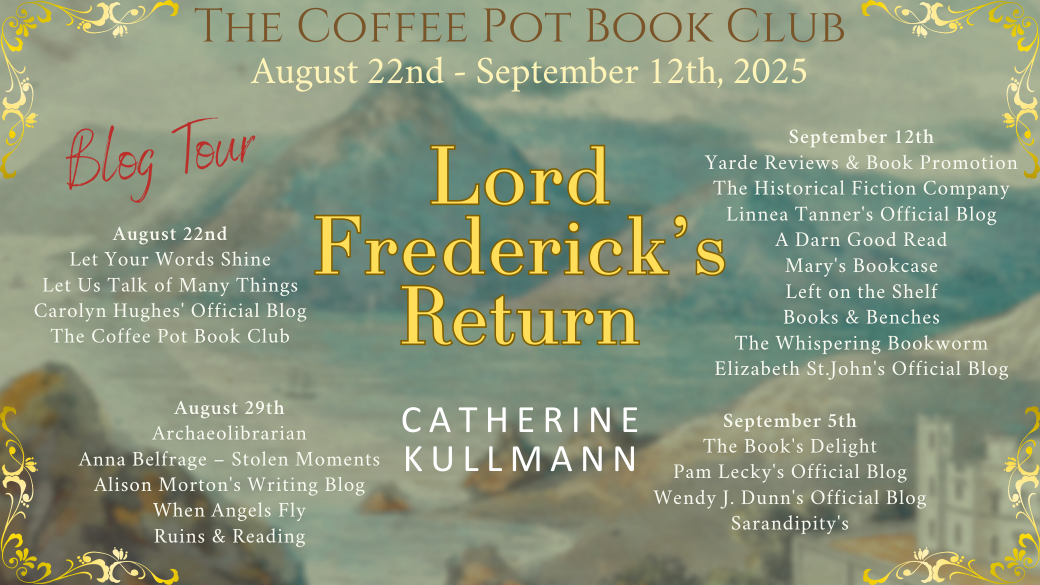
11 Sep Catherine Kullmann Lord Frederick’s Return #Regency #HistoricalFiction #HistoricalRomance #BlogTour #TheCoffeePotBookClub @CKullmmannauthor @cathiedunn
FEATURED AUTHOR: CATHERINE KULLMANN
I’m delighted to welcome Catherine Kullmann as the featured author in The Coffee Pot Book Club Blog Tour being held between August 22nd – September 12th, 2025. Catherine Kullmann is the author of the Regency Romance, Lord Frederick’s Return, published by Willow Books on 22nd July 2025 (269 pages).
Below are highlights of Lord Frederick’s Return, Catherine Kullmann’s author bio, and a guest post on how to do historical research for a book.
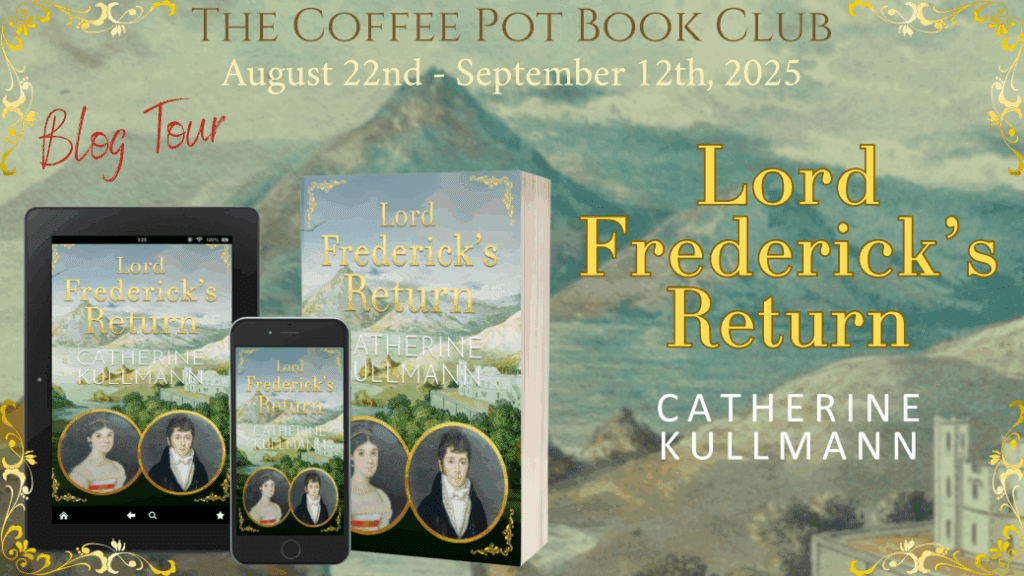
Tour Schedule Page: https://thecoffeepotbookclub.blogspot.com/2025/08/blog-tour-lord-fredericks-return-by-catherine-kullmann.html
HIGHLIGHTS: LORD FREDERICK’S RETURN
Lord Frederick’s Return
By Catherine Kullmann
Blurb:
An older hero, an enigmatic heroine and a delightfully outspoken four-year-old. Throw scandal into the mix for a gripping and tender Regency love story
August 1816. Lord Frederick Danlow returns to England after spending 18 years in India. He plans to make a home for himself and his motherless, four-year-old daughter, Ruperta. Unsure where to start, he accepts an invitation to stay at Ponsonby Place, home of Colonel Jack Ponsonby who made his fortune in India, and his daughter Susannah, the mistress of the household.
Soon Frederick finds himself in need of a governess—and a wife? The more time he spends with Susannah, the more his admiration of her deepens. Is she the woman with whom he will share his life?
He is resolved to court her, but then his younger brother Henry engulfs his family in an appalling scandal that could prevent any lady from agreeing to a connection with it. Now Frederick must support his family during this ordeal.
But what of Susannah? What will she say when she hears of the scandal? Should he, dare he offer her his heart and his hand?
Buy Link:
Universal Buy Link: https://mybook.to/Frederick
AUTHOR BIO: CATHERINE KULLMANN

Catherine Kullmann was born and educated in Dublin. Following a three-year courtship conducted mostly by letter, she moved to Germany where she lived for twenty-five years before returning to Ireland. She has worked in the Irish and New Zealand public services and in the private sector. Widowed, she has three adult sons and two grandchildren.
She has always been interested in the extended Regency period, a time when the foundations of our modern world were laid. She loves writing and is particularly interested in what happens after the first happy end—how life goes on for the protagonists and sometimes catches up with them. Her books are set against a background of the offstage, Napoleonic wars and consider in particular the situation of women trapped in a patriarchal society.
She is the author of The Murmur of Masks, Perception & Illusion, A Suggestion of Scandal, The Duke’s Regret, The Potential for Love, A Comfortable Alliance, Lady Loring’s Dilemma, and The Husband Criteria.
She also blogs about historical facts and trivia related to this era. You can find out more about Catherine’s books and read the blog (My Scrap Album) at her website where you can also subscribe to her newsletter.
Author Links:
Website: http://www.catherinekullmann.com/
Twitter / X: https://twitter.com/CKullmannAuthor
Facebook: https://www.facebook.com/catherinekullmannauthor
Book Bub: https://www.bookbub.com/profile/catherine-kullmann
Amazon Author Page: viewauthor.at/ckullmannamazonpage
Goodreads: https://www.goodreads.com/author/show/15549457.Catherine_Kullmann
GUEST BLOG BY CATHERINE KULLMANN
Several Bloggers on this tour have asked me to write about research for my novel and, to avoid repeating myself, I have decided to write here about historical research in general. Why is research so essential?
Good historical fiction provides insights into yesterday and helps us understand today. It can reveal past, hidden wrongs, teach us to value the struggles of those who went before us and inspire us to preserve and build upon their achievements. It can encourage us to persevere or warn us to change direction. But whatever it is that readers seek, the onus is on us, the authors, to facilitate their transition to that other time and place. To do this, we must be able to step into that other, long-ago world as easily as we step out of our own front door. Yesterday must be as real to us as today is to authors whose books are set now. But, unlike them, we have special homework to do before we start.
A Word of Warning to the novice writer.! Presumably you have decided to set your book in a particular era because it interests you. You already know something about it. BUT UNLESS YOU ARE A HISTORIAN, WHEN YOU START, ASSUME YOU KNOW NOTHING. Check Everything. It is both easy and dangerous to draw on superficial knowledge or to project back in time.
What we know now may not have been known then. We must try and look at the past through contemporaneous eyes. Here are some general questions we need to ask. I have deliberately framed them as broadly and neutrally as possible so that they can be applied to any place and any time, even to a fantasy world. With this information, you string the loom on which you will weave your story.
What Sort of Society was It?
What is the basic social unit?
Is it matriarchal, patriarchal or other?
Who are the rulers?
Is it a democracy, monarchy, oligarchy, or tribal society?
Who are the haves and have-nots?
How was justice administered?
How developed were agriculture, manufacturing and trade?
What was Happening at the Time?
What were the big issues of the day?
Who were the heroes?
Who were the enemies?
What were the scandals?
What was new in Art, Music, Architecture, Literature, Industry, Agriculture?
Next you must create a PUBLIC TIMELINE for the year(s) in which your story is set. By this, I mean the important political, cultural and social events. Here is part of one I drew up for 1816.
- February 1st Opening of Parliament
- February 7th Lord Byron’s The Siege of Corinth and Parsinia are published together
- February 15th Alastor, or, The Spirit of Solitude by Percy Bysshe Shelley is published sometime in mid-February
- February 17th A pistol shot is fired at Miss Kelly from the pit while she was acting in O’Keefe’s farce of “The Merry Mourners” at Drury Lane theatre. The shot was fired by a Mr Barnet who, when taken into custody, proved to be a complete maniac
- 22 Isabella; or, The Fatal Marriage” and “John of Paris.” Theatre Royal, Covent Garden.
- Mr Western MP writes to Creevey in Brussels. “Ruin overwhelms the farmers. I feel convinced a national bankruptcy will be the consequence………I have not any hope of midsummer rents & the generality of landowners will be minus the best part of their interest without a wonderful alteration
- February, the Wedderburn-Websters sue the St James Chronicle for libel and are awarded £2K. (The previous August, the Chronicle reported that the husband of Lady Frances Wedderburn-Webster threatened to sue Wellington and that the Duke had offered £100K “to make up the affair”).
- 29 February – leap year
Think of this timeline as a newspaper—this is what will occupy your characters. You weave this information through your first information set to complete your background, and perhaps find inspiration for your book. I used the incidence of a shot being fired at an actress from the pit in The Potential for Love.
Finally you need the little details that will make your story come to life. From your reading you will be able to glean information about how people lived then. You must consider:
Customs, Ethics and Mores
What were their religion and beliefs?
What behaviour was most highly valued?
How was it rewarded?
What were the worst crimes?
How were they punished?
What were the rites of passage?
Were there double standards?
What happened to people who broke the rules?
Daily Life
Where and how did they live?
What did they live on?
What knowledge did they have and how did they pass it on?
What did they eat and drink?
How did they travel?
What did they wear?
What did they value?
How did they amuse themselves?
How did they communicate?
The big question is where can you find this information? If the society is literate, start with written sources. Diaries, letters, autobiographies, novels, plays, stories, newspapers and journals are obvious sources, but don’t forget cookery books, fashion magazines, tour guides, timetables, manuals on etiquette and letter-writing, sports writing, brochures, pamphlets, advertisements, old bills, and anything else that is of your period..
What images are available for the period? Look for paintings, engravings, comic books, cartoons, daguerreotypes, photographs and film.
The further back you go in time, the more difficult it is to find primary sources but they are there, perhaps hidden in libraries or museums. And don’t forget the physical—buildings, towns and villages, battlefields, open-air museums. Be aware of your environment. Look up—in Dublin, as in many old cities, only the ground floors of buildings have been modernised and you will find the original facades over the shopfronts. Check out archaeological sites, museums, libraries, battlefields, gravestones, churches and church monuments, sculpture, furniture, and other antiques of your period. Visit old houses and estates.
If you have an enquiring mind and an eager eye you will be surprised at what you will find at flea markets, junk shops, or second-hand book shops. Museum shops are another good source and, of course, we are blessed today with the internet. So much is available online, including the full texts of old books on Gutenberg.org, for example. And if you are really stuck, you can always ask an expert. Most are very happy to help you; I wrote to the Marylebone Cricket Club at Lords when I had a question about the laws of cricket in 1814 for A Suggestion of Scandal and got a prompt and most helpful reply.
We must manage our knowledge so that we can find that elusive nugget of information at the back of our mind. We are fortunate that modern IT makes this a lot easier than the days when a card index was the height of sophistication but the bottom line is that it still comes down to sorting and filing. My research library has about 1000 books. In addition, I have a collection of over 100 prints and engravings, some framed and some not, and three folders of press cuttings and other print-outs. I have hung up most of the framed prints as useful visual reminders of how people lived. While I have not gone so far as introducing the Dewey-Decimal system, my books are shelved according to subject e.g. fashion, education, travel, the navy, gardens and herbals, magazines, diaries, memoirs and journals, etc. etc. I also have catalogued them on my PC so that I know what I have and can check quickly if I need information on a particular subject.
But, of course, I also have a lot of digital records. In my Library folder in WORD, I have a huge document called Historical Facts and Trivia where I put all my research, including anything I stumble across when looking for something else. This is broken down by subject and subheadings so it is easily searched and navigated. This is an invaluable resource; I add to it and consult it constantly. The Library folder also contains longer documents I have downloaded.
All this research feeds into my books but in a subliminal way. It enables me to walk in my character’s world and to provide the quirky embellishments that bring it to life.
© Catherine Kullmann 2025
 Twitter: @cathiedunn
Instagram & Threads: @thecoffeepotbookclub
Bluesky: @cathiedunn.bsky.social






Catherine Kullmann
Posted at 05:47h, 12 SeptemberThank you so much for hosting me
Linnea Tanner
Posted at 10:48h, 12 SeptemberHi Catherine–It was my pleasure to host you and feature your Regency Romance, “Lord Frederick’s Return.” I also learned some great tidbits on how to do historical research. Best wishes on your book.
Cathie Dunn
Posted at 04:13h, 15 SeptemberThank you so much for hosting Catherine Kullmann, with a fascinating article linked to her evocative Regency romance, Lord Frederick’s Return.
Take care,
Cathie xo
The Coffee Pot Book Club
Linnea Tanner
Posted at 12:36h, 19 SeptemberHi Cathie–It was my pleasure to host Catherine Kullmann and feature her Regency Romance, Frederick’s Return.