
01 Sep G. M. Baker The Wanderer and the Way #HistoricalFiction #MedievalFiction #SantiagoDeCompostela #BlogTour #TheCoffeePotBookClub @mbakeranalecta @cathiedunn
FEATURED AUTHOR: G.M. BAKER
I’m delighted to welcome G.M. Baker again as the featured author in The Coffee Pot Book Club Blog Tour being held between August 12th – September 2nd, 2025. G.M. Baker is the author of the Historical Fiction, The Wanderer and the Way (Cuthbert’s People, Book 4), published by Stories All the Way Down on March 10th, 2025 (249 pages).
Below are highlights of The Wanderer and the Way, G.M. Baker’s author bio, and a guest post about the historical background of the novel.
Tour Schedule Page: https://thecoffeepotbookclub.blogspot.com/2025/07/blog-tour-the-wanderer-and-the-way-by-g-m-baker.html
HIGHLIGHTS: THE WANDERER AND THE WAY
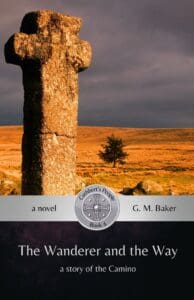
The Wanderer and the Way
(Cuthbert’s People, Book 4)
by G.M. Baker
Blurb:
The Camino de Santiago de Compostela, now the most famous pilgrimage route in the world, was founded in the early ninth century, largely due to the efforts of Bishop Theodemir of Iria Flavia. As with most people of this period, nothing seems to be known of his early years. What follows, therefore, is pure invention.
Theodemir returns footsore and disillusioned to his uncle’s villa in Iria Flavia, where he meets Agnes, his uncle’s gatekeeper, a woman of extraordinary beauty. He falls immediately in love. But Agnes has a fierce, though absent, husband; a secret past; another name, Elswyth; and a broken heart.
Witteric, Theodemir’s cruel and lascivious uncle, has his own plans for Agnes. When the king of Asturias asks Theodemir to undertake an embassy on his behalf to Charles, King of the Franks, the future Charlemagne, Theodemir plans to take Agnes with him to keep her out of Witteric’s clutches.
But though Agnes understands her danger as well as anyone, she refuses to go. And Theodemir dares not leave without her.
Any Triggers: Rape is mentioned by not portrayed.
Buy Link:
Universal Buy Link: https://books2read.com/thewandererandtheway
AUTHOR BIO: G.M. BAKER

Born in England to a teamster’s son and a coal miner’s daughter, G. M. (Mark) Baker now lives in Nova Scotia with his wife, no dogs, no horses, and no chickens. He prefers driving to flying, desert vistas to pointy trees, and quiet towns to bustling cities.
As a reader and as a writer, he does not believe in confining himself to one genre. He writes about kind abbesses and melancholy kings, about elf maidens and ship wreckers and shy falconers, about great beauties and their plain sisters, about sinners and saints and ordinary eccentrics. In his newsletter Stories All the Way Down, he discusses history, literature, the nature of story, and how not to market a novel.
Author Links:
Website Substack Twitter / X Facebook
Book Bub Amazon Author Page Goodreads
GUEST POST: HISTORICAL BACKGROUND
THE WANDERER AND THE WAY
The historical background to The Wanderer and the Way actually starts in a very distant place and with a very distant event, the great Viking raid on the holy island of Lindisfarne in AD 793. That was the event that set in motion the first novel of my Cuthbert’s People series, The Wistful and the Good, which led my main series character, Elswyth, the daughter of a minor Anglo-Saxon thegn living on the coast of Northumbria a little south of Lindisfarne, to find herself, in AD 798, the kidnapped wife of a Viking captain, living in the villa of a lascivious Visigothic lord in the Kingdom of Asturias in Northern Spain.
The late eighth century was a fascinating period with many notable events happening in close proximity. Having emerged from the chaos of the fall of Rome, a new Christian civilization was consolidating itself across Europe. The Roman and Irish churches, cut off for centuries by pagan invasions, had met and reconciled. In Britain it was the latter days of the Northumbrian renaissance, the rootstock of the Carolingian renaissance that occurred under Charlemagne. The great scholar Alcuin built a library in York and became a minister to Charlemagne. Charlemagne was consolidating Frankish control of Western Europe and would be crowned Holy Roman Emperor by the Pope in AD 800.
But Europe was also under attack from several directions. Viking raids had begun, though the Viking conquests of Britain and Normandy were still in the future. The Moors were attempting to complete their conquest of the Iberian Peninsula, the chief Christian holdout being the Visigothic Kingdom of Asturias, ruled by Alonzo the Chaste. In AD 812, Bishop Theodemir of Iria Flavia, in Asturias, would be instrumental in the discovery of the bones of St. James the Great, the patron of Spain, which would lead to the founding of the Camino de Santiago, or Way of St. James, now the most famous pilgrimage route in the world. Alonzo the Chaste was its first recorded pilgrim.
Having stranded Elswyth in Spain with no obvious way to get her home to Northumbria, I turned to a youthful Theodemir and gave him an entirely imaginary youth in which he encountered and fell in love with Elswyth, though she was living under the name Agnes at the time, having been given that name by Mother Wynflaed of Whitby in St. Agnes and the Selkie.
During this period, Alonzo the Chaste sent several embassies to Charlemagne to ask for recognition of his kingship and his help against the Moors. I could find no details of the method or composition of these embassies, so I had Alonzo choose Theodemir for his ambassador, and for his route, I sent him along what is now called the Camino Frances between Saint-Jean-Pied-de-Port and Santiago de Compostela. While it was not feasible to bring Charlemagne himself into the story, he being occupied with the conquest of the Avars at the time, I did contrive for Theodemir and Agnes to have a fruitful interview with Alcuin, then installed as the Abbot of Marmoutier Abbey in Tours.
Another element of the historical period that plays a role in the novel is the Adoptionism Controversy. Adoptionism was a Christian heresy that held that Christ acquired his divinity by adoption, rather than being eternally part of the Trinity as the orthodox position, defined at the Council of Nicaea, had taught. Ideological purity tests have long featured in the conduct of diplomacy, the making of alliances, and the provision of aid. They do so today, and they did so then. Whether one held to the orthodox trinitarian formula of Nicaea or to the Adoptionism doctrine was a vital issue in the day, and so it enters into Theodemir’s mission to Charlemagne.
These great events and issues, however, are merely the background to a much more intimate story about a young man who falls in love with a young woman and strives to save her from a grotesque fate though she herself would prefer to stand and face it in solidarity with the other women who were kidnapped with her, and also as a penance for her own crimes.
 Twitter: @cathiedunn
Instagram & Threads: @thecoffeepotbookclub
Bluesky: @cathiedunn.bsky.social






Cathie Dunn
Posted at 07:56h, 02 SeptemberThanks so much for hosting G. M. Baker today, with such a fascinating post linked to his new novel, The Wanderer and the Way.
Take care,
Cathie xo
The Coffee Pot Book Club
Linnea Tanner
Posted at 19:00h, 03 SeptemberHi Cathie–It was my pleausre to host G.M. Baker and learn more about the fascinating historical backdrop to “The Wanderer and the Way.”