
27 Oct Regina McBride The White Deer #HistoricalFiction #RussianHistoricalFiction #Chekhov #BlogTour #TheCoffeePotBookClub @cathiedunn
FEATURED AUTHOR: REGINA MCBRIDE
I’m pleased to feature Regina McBride in the The Coffee Pot Book Club Blog being held between October 26th – November 6th, 2026. Regina McBride is the author of the Historical Fiction / Russian Historical Fiction, The White Deer, published by Green City Books on September 22nd, 2026 (319 pages).
Below are highlights of The White Deer, Regina McBride’s author bio, and a guest post about the author’s inspiration for writing the novel.

Tour Schedule Page: https://thecoffeepotbookclub.blogspot.com/2026/09/blog-tour-the-white-deer-by-regina-mcbride.html
HIGHLIGHTS: THE WHITE DEER
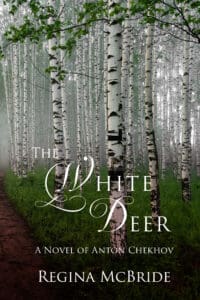
The White Deer
Regina McBride
Blurb:
In the summer of 1879, on his way to Moscow to study medicine, 19-year-old Anton Chekhov, from a bankrupt merchant class family, stops to spend a restful few weeks in the Ukrainian countryside, staying with his friend, Dr. Mitrofan, who is worried about Anton’s lingering bronchitis. It is here that Anton meets Vera Denisova, also 19, a budding actress, the daughter of theater aristocrats from Volkhov, a neighboring estate. The two spend much of their time wandering Volkhov’s vast property, hoping for a glimpse of a white deer that has been spotted in the back acreage.
As they grow closer, Vera confides in Anton about her secret romance and heartbreak over Petya, a servant her age who was gifted at drawing and who she helped to acquire an apprenticeship as a draughtsman in order to leave servitude for good. Anton is fascinated by her obsession, and a triangle forms between Vera, Anton, and the absent Petya. Anton, too, shares his secrets with her, his conflicted relationship with his indigent family and his frustrated wish to publish stories. Surreptitiously through Anton, Vera learns the truth about her family’s declining financial situation and the impending loss of her beloved childhood estate. Together in the long, extended light of summer days, Vera and Anton struggle to come to terms with their feelings for each other and the new profoundly changed world that is waiting for each of them at summer’s end.
The final section of the novel charts the correspondence between Vera and Anton over the next two decades. Vera has become a successful actress and Anton, a doctor who treats peasants for free, has more than realized his ambition as a writer.
In a final letter to Vera before his death at 44 of tuberculosis, Anton reveals that his play, The Cherry Orchard, was inspired by his time with her at Volkhov.
Praise for The White Deer:
“In this stirring tale, McBride evokes a sense of place with lush depictions of birch stands and daisy fields along with a soundtrack of Tchaikovsky and folk tunes, creating a backdrop for Vera’s tender and chaste friendship with Anton. It’s an evocative portrait of a vanishing way of life.” ~ Publishers Weekly
“This transportive novel sweeps the reader up into a vivid, melancholic dream set on a nineteenth century Russian estate. Regina McBride creates her own Chekhovian tragi-comedy that delights as it captures a lost world frozen in time. The White Deer is a gripping must-read for anyone who loves literature and a love story gone awry.” ~ Virginia Pye, author of Marriage and Other Monuments
Buy Link:
Universal Buy Link: https://books2read.com/u/mvaor8
AUTHOR BIO: REGINA MCBRIDE
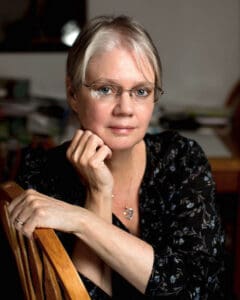
Regina McBride is the author of eight books. The White Deer ~ a novel of Anton Chekhov is her sixth novel. She is also the author of one memoir, Ghost Songs, and one book of poetry.
Her novel, The Nature of Water and Air, was a Booksense Pick (Independent Book Stores Selection), a Barnes and Noble Discover Great New Writers book, and a Borders Original Voices choice. It was optioned for a film. Her books have been translated into five languages.
A recipient of fellowships from the NEA and the New York Foundation for the Arts, Regina lives in New York City, where she taught fiction writing for thirty years at Hunter College and continues to teach privately.
Author Links:
Website: https://www.reginamcbride.com/
Facebook: https://www.facebook.com/profile.php?id=100010471921681
Instagram: https://www.instagram.com/reginamcbride/
Amazon Author Page: https://www.amazon.com/stores/Regina-McBride/author/B001IXMGLE
Goodreads: https://www.goodreads.com/author/show/71686.Regina_McBride
GUEST POST: INSPIRATION FOR THE WHITE DEER

This book has had its roots in my unconscious since I first read Anton Chekhov’s play, The Seagull when I was an eighteen year old aspiring actress. The Seagull is set outside near a lake on a summer evening. An amateur production is about to be performed on a makeshift outdoor stage, and before that starts, different characters appear and talk with each other in earnest about what they long for but do not have.
The Seagull is about an endless chain of unrequited love. One young woman wears black and declares that she is in mourning for her life. And the young man whose play is about to be performed counts the petals of a flower–she loves me, she loves me not–thinking not about the young woman he is attached to, but of his mother, an actress whose approval he aches for and whose judgment he fears.
Two years after reading The Seagull I was cast in The Cherry Orchard, Chekhov’s final play and his masterpiece, which is about the loss of a family estate and the fall of the Russian aristocracy. I got to live and breathe that rich Chekhovian world. Of course my passion for Chekhov intensified and when the production was over I was grief stricken.
In any thing I’ve read by Chekhov, his plays or his stories, there is a quality I find extremely attractive but difficult to define. Hs writing places me in a particular atmospheric world that is uniquely his.
I wanted to write something about that world so that I could live and breathe in it again with the intensity I’d experienced while performing in The Cherry Orchard. And I wanted to write about Chekhov himself, to include him as a character in the novel. I wanted to write an epic novel that spanned the big events of Chekhov’s life.
Over the course of twenty five years, I wrote five different iterations. In the mold of the epic Russian novel, all of them were well over four hundred pages, two over five hundred. But they never came together cohesively, and I often felt my Anton was too elusive. I didn’t feel like I could quite grasp him. I thought sometimes it was punishment for daring to do something as sacrilegious as trying to write about Anton Chekhov as a fictional character. I set the book aside many times, sometimes in complete despair, not sure I would ever go back to it. But I always did. And I kept reading, everything that Chekhov wrote, plus critical studies and biographies. I saturated myself for years in Chekhov’s language and in his world, hoping to somehow find my way into it.
Reading Anton Chekhov’s letters, I felt at times as if he was engaging me directly. They are often as detailed and beautiful as his best prose and they gave me a feeling for the cadence of his voice. They are charming, filled with his humor and incredible self-deprecation.
One day while skimming through his letters, I came across some writing advice Anton had offered his older brother, Alexander. “Brevity is the sister of talent,” he had written. He was encouraging Alexander to be more concise. I’d long appreciated that Anton was a master of economy but had never applied that insight to my own novel, which I’d always imagined as a great ship I hoped to guide one day into port. Chekhov himself had never written a novel. He had seen stories in smaller frames. He’d written plays, novellas and hundreds of stories. I began to see the folly of attempting to write an epic novel involving a writer whose work was the soul of moderation. I reduced the timeline of the story dramatically. I set most of the book in the summer of 1879, and focused it on the relationship between Anton and Vera Denisova, the narrator of this novel. Vera is the daughter of an aristocratic family and the granddaughter of a famous actress, now deceased. I knew that when Anton Chekhov was nineteen and was on his way to Moscow to study medicine, he did in fact stop in the Ukrainian countryside for several weeks to see friends, so I set the story in this period of relaxation before his move to Moscow. Anton’s character came forward as if he could suddenly breathe. Maybe I had been putting too much pressure on him in the more lengthy, linear narrative. Maybe he had too much work to do. But this period with less demands on him, he began to relax.
Like The Seagull, my novel, The White Deer, involves the theater, and like The Cherry Orchard it is about the loss of a family estate and the decline of the Russian aristocracy.
All the characters, consciously or unconsciously, are riding on a rising wave of history, leaving an older world for a newer, unknown one. Vera and Anton are aware that the ancient trees and orchards of Volkhov, Vera’s childhood estate, are likely to fall to the axe at summer’s end. They talk about wanting to stop time and remain together wandering the acreage, so the trees will never be gone and the land never developed.
 Twitter: @cathiedunn
Instagram & Threads: @thecoffeepotbookclub
Bluesky: @cathiedunn.bsky.social






Cathie Dunn
Posted at 13:33h, 27 OctoberThank you ever so much for hosting Regina McBride today, Linnea. We really appreciate your time.
Take care,
Cathie xo
The Coffee Pot Book Club
Linnea Tanner
Posted at 22:36h, 27 OctoberHi Cathie–It was my pleasure to host Regina McBride and feature her novel, “The White Deer.”