
05 Oct Janet Wertman What Love E’er Meant #WhatLove #HistoricalFiction #BiographicalHistoricalFiction #Tudors #ElizabethI #BlogTour #TheCoffeePotBookClub @cathiedunn
FEATURED AUTHOR: JANET WERTMAN
I’m delighted to welcome Janet Wertman as the featured author in the The Coffee Pot Book Club Blog being held between September 22nd – October 13th, 2026. Janet Wertman is the author of the Historical Biographical Fiction, What Love E’er Meant (Regina Book #2), independently published by the author on September 7, 2026 (432 pages).
Below are highlights of What Love E’er Meant, Janet Wertman’s author bio, and a post about the political background in the time of the novel.
Tour Schedule Page: https://thecoffeepotbookclub.blogspot.com/2026/09/blog-tour-what-love-ever-meant-by-janet-wertman.html
HIGHLIGHTS: WHAT LOVE E’ER MEANT
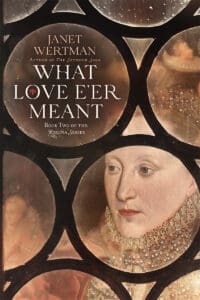
What Love E’er Meant
(Regina Book #2)
by Janet Wertman
Blurb:
A new queen must prove she deserves the throne God gave her, while the path everyone insists will secure it might cost her everything
Against all odds, Elizabeth Tudor has become Queen of England. Determined to fulfill what she sees as a divine responsibility, she sets out to heal a country ravaged by religious discord, war, and debt – and vindicate the legacy of Anne Boleyn, the mother who did not deserve her fate.
But Elizabeth’s crown is not fully secure: to the Catholic world, her cousin Mary Stuart is the rightful Queen of England and there are rumblings to put her there. Shoring up defenses requires that Elizabeth challenge France’s control of Scotland and Spain’s dominance on the seas, as well as calm internal strife. Above the din of menace, one question dominates all others: who will she marry?
William Cecil, her trusted Secretary of State, urges her to secure an alliance through a strategic match. Robert Dudley, the love of her life, pressures her to choose him. And Mary herself presents a cautionary tale. In the end, Elizabeth chooses not as a woman but as a queen, and learns the sobering truth of sovereignty: to rule is to stand alone.
What Love E’er Meant, the searing second volume in the Regina Trilogy, captures a young queen’s struggle to balance love and power, duty and desire…and the profound cost of choosing crown over heart.
Buy Links:
Amazon & Apple Ebook Buy Link: https://books2read.com/u/4XqdD7
Kobo: https://www.kobo.com/us/en/ebook/what-love-e-er-meant?
Barnes & Noble: https://www.barnesandnoble.com/w/what-love-eer-meant-janet-wertman/1151015402
AUTHOR BIO: JANET WERTMAN

Janet Wertman’s critically acclaimed, character-driven historical novels reflect a passion for the Tudor era she had harbored since she stayed up late at age eight to watch The Six Wives of Henry VIII and Elizabeth R.
Her Seymour Saga trilogy (Jane the Quene, The Path to Somerset, The Boy King) took her deep into one of the era’s central families – and now her follow-up Regina series (Nothing Proved and What Love E’er Meant out now, Forever Gloriana to come) explores Elizabeth’s journey from bastard to icon.
She shares interesting takes on the Tudors at www.janetwertman.com and her YouTube channel @TooMuchTudor.
Author Links:
Website Facebook Author Instagram Tudor Instagram Bluesky
Pinterest Book Bub TikTok YouTube Amazon Author Page Goodreads
POLITICAL BACKGROUND: WHAT LOVE E’ER MEANT
When Elizabeth came to the throne, all of the politics converged around the issue that would define England in the world: religion.
Henry VIII’s break with Rome had been groundbreaking – and incredibly dangerous. An excommunicated monarch was isolated, an easy target for attempted assassination and holy wars. Henry worried about this, as did Elizabeth (perhaps with more justification: her clear Catholic successor did indeed inspire crusades, even after death). Yet when Mary I brought England back into the Catholic fold, the country saw first-hand how little they gained: while alignment with Rome kept England integrated with the important Catholic European powers (Spain, France, the Holy Roman Empire, the Italian States..), the fact was that Rome was not putting England first in anything. Indeed, the Pope sided with France against Spain and England, reminding many Englishmen how much they hated being subject to the whim of foreign powers.
Elizabeth’s England had to be Protestant: the very Church of England had been founded to give her the legitimacy that the Catholics would always deny her. But turning England back to Protestantism once it had reinstated Papal sovereignty was not certain to pass Parliament. Yes, the Commons were overwhelmingly Protestant, pressing to restore the more radical reforms achieved under Edward VI (which actually made them unwilling to call a woman Head of the Church). But the House of Lords was quite conservative: Bishops made up more than a third of the voting, and they were all staunch Catholics appointed by Mary. Elizabeth’s middle road – a church that looked more like her father’s than her brother’s (and named her the lesser “Supreme Governor” – conservatives were misogynistic too) – was the only way to capture enough peers to overcome the Bishops’ voting bloc. It was also a choice that seemed to resonate with the new Queen’s somewhat fluid views of religion.
Even then, the compromise would not have been possible without enormous luck. Cardinal Reginald Pole, England’s Lord Chancellor, died the same day as Mary, removing not only his vote but also his effective opposition to reform. The same influenza epidemic also carried off four more bishops within the month, adding to the six unfilled bishoprics that Pole’s illness prevented him from addressing. Even with this huge swing, comfort required just one more sleight of hand: a legal pretext to arrest two Bishops so that they were lodged in the Tower and missed the voting. In the end, the Act of Supremacy was able to pass by three votes.
Religious issues would continue to be the central debate for all Elizabeth’s reign: as the Protestants gained in power, they pushed harder for still more reforms. Elizabeth continued to rein them in as best she could, forever insistent that her Catholic subjects must have a way to worship in the Church of England without destroying their consciences. The compromise was one of her greatest accomplishments, all the more impressive for being one of her very firsts.
 Twitter: @cathiedunn
Instagram & Threads: @thecoffeepotbookclub
Bluesky: @cathiedunn.bsky.social






No Comments