
29 Sep Marilee Aufdenkamp Sparrow’s Song #SparrowsSong #NurseToNovelist #HistoricalFiction #ArmySchoolOfNursing #CadetNurseCorps #BlogTour #TheCoffeePotBookClub @cathiedunn @maryanneyarde
FEATURED AUTHOR: MARILEE AUFDENKAMP
I’m delighted to welcome Marilee Aufdenkamp as the featured author in the The Coffee Pot Book Club Blog being held between September 21st – October 2nd, 2026. Marilee Aufdenkamp is the author of the Historical Fiction, Sparrow’s Song, published by Old Fort Press on 18th September 2026 (292 pages).
Below are highlights of Sparrow’s Song, Marilee Aufdenkamp’s author bio, and a post about her historical research for the novel.
Tour Schedule Page: https://thecoffeepotbookclub.blogspot.com/2026/09/blog-tour-sparrows-song-by-marilee-aufdenkamp.html
HIGHLIGHTS: SPARROW’S SONG
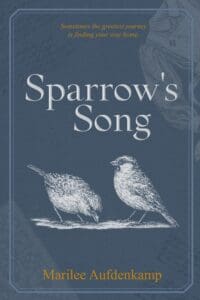
Sparrow’s Song
By Marilee Aufdenkamp
Blurb:
Shortly after Kathryn Scheibel leaves her cigar‑making job in 1917, she enters the Army School of Nursing, a pioneering WWI nurse‑training program that offers the education she’s longed for but couldn’t afford. More than two decades later, her career carries her, as an instructor, into the Cadet Nurse Corps, the federal WWII nursing‑education initiative created to support the war effort. There she sees the same pressures she once felt now directed at students with even fewer protections. When two Black students are treated unfairly, Kathryn must decide how to respond.
Sparrow’s Song is a sweeping, intimate novel about resilience and belonging, rooted in the real history of wartime federal nursing education and the evolving landscape of modern American nursing. At its heart is a young immigrant woman pushing herself toward the advantages she’s convinced education will unlock, even as that drive pulls her away from the people and heritage she loves.
Trigger Warnings (brief, non‑graphic):
- Two off‑page suicides
- One short scene involving sexual harassment / coercion
- One brief scene of non‑graphic violence
Buy Link:
Universal Buy Link: https://books2read.com/u/3GyLvO
AUTHOR BIO: MARILEE AUFDENKAMP

Marilee Aufdenkamp is a retired nurse educator who taught undergraduate nursing for twenty‑six years before turning her full‑time focus to historical fiction. She writes early to mid‑twentieth‑century stories grounded in immigrant experience and working‑class life.
Her debut novel, Sparrow’s Song, was inspired by her early nursing career in Nebraska, where she came to admire the Germans from Russia she cared for at the end of their lives.
Originally from Southern California, she has spent her adult life in Nebraska.
Author Links:
Website: https://marileeaufdenkamp.com
Facebook: https://www.facebook.com/MarileeAufdenkampWriting/
Instagram: https://www.instagram.com/marileeaufdenkampwriting/
Goodreads: https://www.goodreads.com/author/show/55952096.Marilee_Aufdenkamp
HISTORICAL RESEARVH: SPARROW’S SONG
The research for Sparrow’s Song covered many areas of early twentieth‑century life. I read deeply in anything the story touched: brick making, cigar making, the jewelry industry, nursing reforms, the Army School of Nursing, the Cadet Nurse Corps, and the history of the Germans from Russia. The research was extensive and meticulous, and I verified details down to the minutiae.
Over the years, I filled three spiral‑bound notebooks with notes, timelines, quotations, and source details. I read widely and consulted books on brick and cigar making, the jewelry industry, the history and design of Central Park, nursing practices and reforms, the Army School of Nursing, and the evolution of nursing education in the early to mid‑twentieth-century. I read old nursing textbooks, studied curricula, and located the names of Army School of Nursing instructors.
For the Germans from Russia portions of the story, I read histories of their lives in Russia during and after the era of Catherine the Great, as well as books about their immigration to the United States and settlement on the Plains. One of the most meaningful works was Children of the Volga by Dr. George Bruntz, who immigrated to Hastings (the town that inspired my fictional Gorham, Nebraska) as a boy and later became a college educator and administrator.
I also relied on The Lamp and the Caduceus, published by the Army School of Nursing Alumnae Association, which offered an insider’s view of the federal nursing program that shaped Kathryn’s early studies. For the jewelry industry, I read Diving for Starfish by Cherie Burns, Summer at Tiffany by Marjorie Hart, and The Retail Jeweler’s Guide by Kenneth Blakemore so I could understand the work, settings, and culture of that world well enough to write about it accurately.
Alongside these printed works, I consulted additional books that helped me understand the historical worlds represented in Sparrow’s Song. For the Germans from Russia background, I read That’s the Way it Once Was by Arnold Marzolf and The Story of Russia’s Germans from Catherine to Khrushchev by Adam Giesinger. To support the sections involving the Cadet Nurse Corps, I relied on Cadet Nurse Stories by Thelma Robinson and Paulie Perry, The United States Cadet Nurse Corps [1943–1948] published by the U.S. Public Health Service, and Your Country Needs You by Thelma Robinson. Other nursing history sources included American Women of Nursing by Edna Yost, Anatomy and Physiology for Nurses by Kimber and Gray, and Cornerstone of Nursing Education by Teresa Christy. For industrial background, I consulted Once a Cigar Maker by Patricia Cooper for the cigar‑making industry and The Great Hudson River Brick Industry by George Hutton for brick making. I also used Once Upon a Town by Bob Greene for information on WWII canteens. For birding accuracy, I relied on Roger Tory Peterson’s A Field Guide to the Birds and David Allen Sibley’s Sibley’s Birding Basics.
Additional historical works included A History of Women in America by Carol Hymowitz and Michaele Weissman, Central Park Then and Now by Marcia Reiss, Foreign and Female Immigrant Women in America, 1840–1930 by Doris Weatherford, This Is Who We Were: In the 1920s from Grey House Publishing, and Travel by Pullman by Joe Welsh and Bill Howes.
My research extended far beyond books. I studied old newspapers, visited archives and historical societies, interviewed former Cadet Nurse Corps nurses, and spent hours listening to stories and examining artifacts shared by a close family friend who grew up immersed in the Germans from Russia community in Hastings, Nebraska. She drove me around town pointing out landmarks from her childhood, accompanied me to two Germans from Russia conventions, and traveled with me to Hays, Kansas, to visit the Fort Hays State University Germans from Russia archives.
I corresponded and met with Dr. Michael Miller, Director Emeritus of the Germans from Russia Heritage Collection at the NDSU Libraries. He connected me with members of his Germans from Russia listservs, who answered a question for me about funeral customs in the 1940s.
I found information online about jewelry items sold in New York estate auctions in the 1930s. I verified train schedules and incorporated historically documented details—such as the upholstery and wallpaper in a particular club car my protagonist travels in—whenever I could confirm them. I checked weather reports for specific historical dates. I read birding books and verified that a species seen out of range in the novel had actually been documented far from its natural habitat in that same area.
Several years into the project, I misplaced the first of my three notebooks and a computer crash erased much of my early digital search history and many files. Because of that, I cannot reconstruct the notes for every title or source I consulted, though the information had already been woven into the manuscript.
There is one small exception to my otherwise complete verification. Early in my research, I found detailed information about how penicillin suspended in peanut-oil and combined with beeswax was prepared and administered during World War II. At that time, penicillin had a short half‑life. It was used to treat venereal disease in soldiers, but maintaining therapeutic blood levels required injections every four hours, which was not practical in wartime. Suspending penicillin in oil and adding beeswax prolonged its duration of action and extended the dosing interval to every twelve hours.
I once had a clear explanation of how the beeswax and peanut‑oil penicillin mixture was warmed to melt the wax so it could be injected. I am almost certain it involved a hot‑water bath, though it may have been an electric incubator. That information was saved in a digital file that was lost in the computer crash. Despite extensive searching, I was never able to relocate the original source or find as much detail as I had before. This is the only instance in which I could not later re‑verify a fact to the same degree of certainty as the rest of my research. I included it anyway to the best of my recollection and acknowledged the reliance on memory in my author’s note.
So, the research for Sparrow’s Song was a mix of reading, listening, traveling, digging, and learning from people who lived the history or inherited it. The work was grounded in print materials, archival sources, and firsthand accounts, and it reflects years of careful inquiry and documentation.

X/Twitter: @cathiedunn @maryanneyarde
Instagram: @thecoffeepotbookclub @yardereviews






No Comments