
04 Aug Karen Essex Renaissance Rivals #HistoricalFiction #RenaissanceFiction #WomenofHistory #RenaissanceWomen #IsabelladEste #LucreziaBorgia #RenaissanceItaly #BlogTour #TheCoffeePotBookClub @KarenEssex @cathiedunn
FEATURED AUTHOR: KAREN ESSEX
I’m delighted to welcome Karen Essex as the featured author in the The Coffee Pot Book Club Blog being held between July 29th – August 19th, 2026. Karen Essex is the author of the Historical Fiction, Renaissance Rivals (Sequel to Leonardo’s Swans), published by Kleopatra Books on July 18, 2026 (311 pages).
Below are highlights of Renaissance Rivals, Karen Essex’s author bio, and an excerpt from the novel.
Tour Schedule Page: https://thecoffeepotbookclub.blogspot.com/2026/07/blog-tour-renaissance-rivals-by-karen-essex.html
HIGHLIGHTS: RENAISSANCE RIVALS
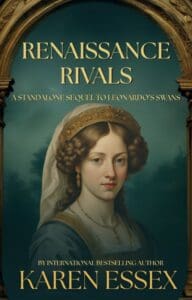
Renaissance Rivals
(Sequel to Leonardo’s Swans)
By Karen Essex
Blurb:
Renaissance Rivals, the long-awaited sequel to the global bestseller Leonardo’s Swans, tells the story of the brutal rivalry between two of history’s most fascinating power women: Isabella d’Este, Marchesa of Mantua, celebrated in her own lifetime as “The First Lady of the World,” and Lucrezia Borgia, Duchess of Ferrara, daughter of the infamous Pope Alexander VI and one of the most maligned women in history.
Before Maggie O’Farrell’s doomed duchess in The Marriage Portrait, there were the women who built the courts, forged alliances, and commanded works of artistic genius. In both Renaissance Rivals and Leonardo’s Swans, Essex invites readers to step back one generation into the glittering courts of Renaissance Italy, where beauty, intellect, marriage, and ambition could determine the fate of nations.
Any Triggers: Child loss; miscarriages.
Buy Links:
Universal Buy Link: https://books2read.com/u/mdpO2E
For paperback orders: https://shop.karenessex.com
This book is available to read on #KindleUnlimited.
AUTHOR BIO: KAREN ESSEX

Karen Essex is the national and international bestselling author of RUN, DARLING, KLEOPATRA, PHARAOH, LEONARDO’S SWANS, STEALING ATHENA, DRACULA IN LOVE, AND BETTIE PAGE: LIFE OF A PINUP LEGEND. All feature iconic women—powerful women that seduced the world and ruled it.
Essex is also an active screenwriter and speaker, and an award-winning journalist. She divides her time between Los Angeles, New Orleans, and Europe. Her novels are published in twenty-nine languages.
Leonardo’s Swans, the prequel to Renaissance Rivals, was a runaway bestseller in Italy and won the prestigious Premio Roma for Foreign Fiction.
Author Links:
Website Twitter / X Facebook Instagram Pinterest
Book Bub TikTok Amazon Author Page Goodreads
Follow Karen’s Substack newsletter, History. Sex. Power
EXCERPT: RENAISSANCE RIVALS
Ferrara, February 1502
The bride’s arrival had been timed to coincide with Carnival in Ferrara, that week of Bacchanalia when the hedonistic Lord of Misrule celebrated his final days of pleasure before the Lady of Repent restored sacrifice and prayer on Ash Wednesday.
Ordinarily, Isabella loved spending the season in Ferrara, when the city swelled with revelers and the streets transformed into theaters without walls. This year, however, she would far rather have remained in Mantua enjoying quieter festivities with Francesco and their children than hosting extravagant celebrations for a bride imposed upon her family.
Five thousand guests were expected, all arranged by her father so he would not appear parsimonious, which he most certainly was, before the open-handed Borgia pope.
To Isabella’s irritation, Francesco had been forced to remain behind in Mantua. Based upon intelligence reports, they both suspected Cesare Borgia intended to strike territories dangerously close to their borders.
“We would be fools to trust a Borgia not to attack Mantua even while his sister marries your brother,” Francesco had argued. “Who can say he and his father did not arrange the marriage solely to distract us while he seizes our lands? Neither man possesses honor or shame.”
“And who is to say,” Isabella added, “that the sister herself is not part of the scheme, if not its architect?”
With Francesco absent, the honor of escorting Isabella should naturally have fallen to her brother Cardinal Ippolito. Instead, detained in Rome, he had sent his secretary, a handsome young scholar Isabella had met only that morning.
How had Mario Equicola obtained so visible and privileged a position beside the hostess of the wedding festivities? There had been no time to question the arrangement. If Ippolito entrusted Mario with her care, he either held the man in extraordinarily high esteem or possessed some separate purpose involving him.
That, Isabella trusted, would reveal itself in time, as all human and divine agendas eventually did.
There existed only so much speculation in which a sensible person should indulge.
And so she walked slowly toward the bucentaurs that had borne the bridal party upriver to Ferrara, feeling the icy stones beneath the soft leather of her boots and the cold seeping into her already frigid heart as she prepared to welcome the newest member of her ancient family.
The delicate bride, it seemed, had complained that her bones felt broken from endless carriage travel and demanded that the remainder of the journey occur by river.
As the procession reached the docks and waited for the bridal party to disembark, the wind whipping across the water turned Isabella’s nose, she was certain, an appalling shade of red. She shivered, and Mario tightened his hold gently upon her arm.
“Allow me, Your Excellency,” he said warmly. “Cardinal Ippolito specifically instructed me to care for you in his absence.”
She liked the warmth and sincerity in his voice enough that she began discreetly studying him in sidelong glances. His light chestnut hair fell forward in soft waves from a high brow, while his long aquiline nose gave him the aspect of an ancient Roman bust.
His velvets and fox-trimmed garments signaled fashionable ambition, despite his lacking the wealth for ermine or jewels. His eyes shifted intriguingly from sharp awareness to softness within moments.
Then, as if sensing her silent appreciation, he leaned close and murmured boldly into her ear.
“If I may say so, Your Excellency’s beauty and glamour shall eclipse the bride entirely. Had Madonna Lucrezia understood how many eyes would turn toward you today, she would have entered Ferrara under cover of darkness.”
Had he not enjoyed Ippolito’s favor, Isabella might have corrected his impertinence.
Mario was a scholar of some reputation, though she had found his celebrated treatise much like the work of most learned men: exhaustive contemplation of the obvious.
Now he had ventured into dangerous territory with such open admiration. He waited expectantly for her response, and she gave him none. Years among ambitious poets and scholars had taught her to allow flattering words to drift harmlessly through the mind like passing breezes.
“Ah,” he said lightly. “I see my impudent admiration has not been well received.”
Isabella offered only the faintest smile. “I stand here today without my husband’s protection, sir, and therefore depend upon you to shield me from men wishing to exploit that circumstance.”
Not to become one of them, she thought privately.
Mario understood immediately. His cheeks reddened. “You may rely upon me entirely,” he answered with a formal bow.
Isabella had no intention of taking Mario Equicola seriously, yet his observations pleased her, particularly because they echoed her own suspicion that she would indeed eclipse the bride.
Besides, he cut a fine figure on such a cold, bright day while she performed a duty she deeply resented.
She found herself occupied by the shape of his upper lip, with its elegant red curves, and wondering unexpectedly what it might feel like between her teeth.
Young admirers frequently surrounded Isabella at every court, competing for invitations to Mantua and begging her patronage. Rarely did any provoke genuinely improper thoughts. Why this one did so she could not determine.
Perhaps because Ippolito valued him so highly. Perhaps because she agreed wholeheartedly with his assessment of her appearance.
Indeed, Isabella had dressed deliberately to command notice, especially after reading Machiavelli’s meticulous letters detailing every aspect of Lucrezia’s trousseau.
Thank God she had not relied solely upon her brothers’ reports. Ferrante wrote chiefly of bullfights, Cesare’s horses, and how amusing Rome’s courtesans found him. Ippolito focused upon politics. Sigismondo, most easily charmed of them all, praised Lucrezia’s dancing, manners, and beautiful hair.
Only Machiavelli truly satisfied Isabella’s curiosity. He described the bride’s clothing, grooming habits, jewels, and even the techniques used to bleach her naturally brown hair blonde.
He had also examined Lucrezia’s books, largely devotional works befitting a convent education. Little intellectual curiosity, Isabella concluded. A library revealed character more accurately than almost anything else.
Lucrezia owned mostly prayer books and one volume of Spanish love poetry.
She is the light of His Holiness’s eyes, Machiavelli had written. As she departed Rome, the pope reportedly ran from window to window watching her progress until she vanished from sight.
In conclusion, she is a sweet and graceful lady. Her eyes brightened at mention of Your Excellency’s name and the possibility you might soon become sisters. She is wiser than appearances suggest, and one must keep one’s wits about one while speaking with her.
From the letters, Isabella wondered whether Machiavelli himself had fallen beneath Lucrezia’s spell.
Men were absurdly vulnerable to blondes. As a natural blonde, Isabella understood perfectly why every Italian courtesan owned golden wigs.
Whatever Machiavelli’s motivations, he had served her well, allowing her to craft an appearance that reflected not merely wealth and status, but intellect. She wore black velvet lined with rare white lynx fur over a deep green vest embroidered in gold and rubies forming one of her mysterious personal devices: an empty musical pentagram.
Mario noticed immediately. “Your Excellency, your reputation for musical genius echoes through every court in Europe, and yet today you wear five empty musical lines. Is this a riddle?”
“Only the truly inspired understand it,” Isabella answered teasingly. Was she flirting? “Does it puzzle a man of your erudition?”
She smiled directly into his eyes. Yes. She was flirting.
“I assume,” Mario replied, “that the message suggests silence is the most beautiful sound of all. Silence possesses great mystery and power, much like certain women who dominate rooms by saying nothing.”
Ah. He flirted equally well in return. “The ancients understood silence deeply,” he continued. “Indeed, they worshipped a god devoted to it.”
“Harpocrates,” Isabella interrupted. “The winged child holding one finger to his lips, cautioning worshippers to adore the gods through silent awe rather than endless self-serving prayers.”
Mario pressed one elegant hand theatrically against his heart. “Your reputation as a learned woman falls far short of reality.”
Isabella drew her fur tighter around herself. Today, her device served less philosophical purpose than practical one. No person deserved silence more thoroughly than Lucrezia Borgia herself.
If the woman possessed any intelligence at all, she would remain quiet and conceal herself behind magnificent gowns. Yet Isabella doubted Lucrezia was subtle enough to grasp the message.
Perhaps another guest would explain it to her.
 Twitter: @cathiedunn
Instagram & Threads: @thecoffeepotbookclub
Bluesky: @cathiedunn.bsky.social






Cathie Dunn
Posted at 04:57h, 06 AugustThank you so much for hosting Karen Essex, sharing an enticing excerpt from her intriguing new novels, Renaissance Rivals. We appreciate your time.
Take care,
Cathie xo
The Coffee Pot Book Club
Linnea Tanner
Posted at 16:04h, 06 AugustHi Cathie–It was my pleasure to host Karen Essex and feature her intriguing novel, “Renaissance Rivals.”