
16 Jul Jon Byrne Soldiers of Christ #HistoricalFiction #HistoricalAdventure #NorthernCrusades #ReaderReach #BlogTour #TheCoffeePotBookClub #YardeBookPromotions @cathiedunn @maryanneyarde
FEATURED AUTHOR: JON BYRNE
I’m delighted to welcome Jon Byrne as the featured author in The Coffee Pot Book Club Blog Tour being held between July 10th – 31st, 2026. Jon Byrne is the author of the Historical Adventure, Soldiers of Christ (Book 2 of The Northern Crusader Chronicles), published by The Book Guild on 28th April 2026 (388 pages).
Below are highlights of Soldiers of Christ, Jon Byrne’s author bio, and a guest post entitled, “The Northern Crusades: A History of Conflict and Conversion.”
Tour Schedule Page: https://thecoffeepotbookclub.blogspot.com/2026/06/blog-tour-soldiers-of-christ-by-jon-byrne.html
HIGHLIGHTS: SOLDIERS OF CHRIST
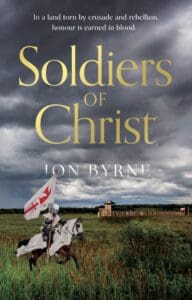
Soldiers of Christ
(Book 2 of The Northern Crusader Chronicles)
By Jon Byrne
Blurb:
In a land torn by crusade and rebellion, honour is earned in blood.
1205. Richard Fitz Simon has fled England after his title was usurped, joining the Livonian Order of Swordbrothers – a German brotherhood of warrior-monks fighting to bring the word of God to the pagan frontier. After slaying the Lithuanian champion at the Battle of Rodenpois, Richard is celebrated by the Order and their Semigallian allies.
Yet his position remains precarious. Jealous rivals question his right to stand among the brotherhood, and his master, Knight-brother Rudolf, is enraged by Richard’s disobedience. When dark secrets from Lübeck resurface, Richard also finds himself at odds with Bishop Albert, head of the Christian mission in Livonia. As he struggles to reconcile faith, duty and identity, he is drawn into a brutal world of suspicion and bloodshed.
Sent on an expedition to build a castle deep in the wilderness, Richard soon sees tensions erupt – and the path he has chosen threatens to destroy everything he has fought to become.
Any Triggers: Mild swearing, medieval battles, some violence
Buy Links:
Universal Buy Link: https://books2read.com/u/bz0eaZ
Google Play: https://play.google.com/store/books/details?id=uQnLEQAAQBAJ
Kobo: https://www.kobo.com/gb/en/ebook/soldiers-of-christ-1
AUTHOR BIO: JON BYRNE

Jon Byrne, originally from London, now lives with his German family by a lake in Bavaria with stunning views of the Alps. As well as writing, he works as a translator for a local IT company and occasionally as a lumberjack. He has studied the medieval world for over twenty years, building up a comprehensive personal library and a particular interest in the often-overlooked Northern Crusades.
Soldiers of Christ is Book Two of The Northern Crusader Chronicles, a gritty, historically grounded series focused on realism, moral ambiguity, and the brutal realities of medieval warfare.
Written for readers who value authenticity and atmosphere over romanticised adventure, the novel explores a largely forgotten crusading frontier, culminating in the first of many confrontations in a harsh wilderness of forest and swamp.
Readers who enjoy the historical detail of authors such as Bernard Cornwell, Conn Iggulden, or Ben Kane may find familiar ground here.
Author Links:
Website: https://www.jonbyrnewriter.com/
Facebook: https://www.facebook.com/JonByrneAuthor
Amazon Author Page: https://www.amazon.co.uk/stores/author/B0DJC6PL8D
Goodreads: https://www.goodreads.com/book/show/249448581-soldiers-of-christ
GUEST POST
The Northern Crusades: A History of Conflict and Conversion
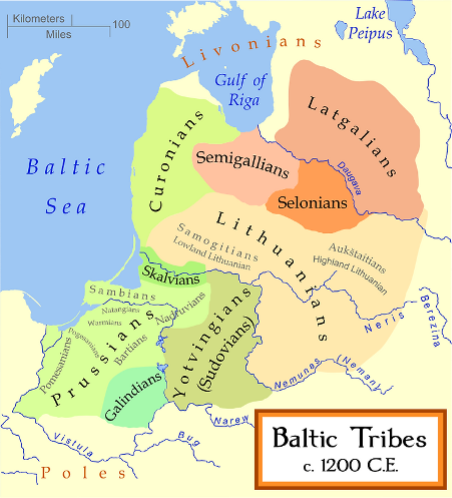
MapMaster – Own work based on: a map by Marija Gimbutas, published in The Balts (1963) LCC 63018018. Available at Vaidilute.com (page 23 “Fig. 1. Baltic tribes and provinces c. A.D. 1200” archive). This map was obtained from Wikipedia.
When most people think of the Crusades, they often turn to the extensive wars waged in the Middle East between Christian and Muslim forces. However, another series of crusades took place in Northern and Eastern Europe – an often-overlooked chapter of history known as the Northern Crusades. These campaigns, spanning from the late 12th to the early 15th century, were launched by Catholic powers against the pagan and Orthodox Christian peoples of the Baltic region.
The Northern Crusades were a direct extension of the broader medieval crusading movement, which had begun with Pope Urban II’s call for the First Crusade in 1095. By the late 12th century, the Catholic Church had turned its focus northward, seeking to expand Christendom into territories populated by pagans such as the Old Prussians, Livonians, Estonians, and Lithuanians.
In 1193, Pope Celestine III formally called for a crusade against these non-Christian peoples, encouraging European monarchs and military orders to take up the cause. Unlike the Middle Eastern Crusades, which primarily aimed to reclaim the Holy Land, the Northern Crusades were largely driven by the desire to conquer and convert, mostly by force.
Several powerful groups played crucial roles in the Northern Crusades:
- The Teutonic Order: Originally a German military order founded in the Holy Land, the Teutonic Knights became the dominant force in the Baltic Crusades. They established a vast territory in Prussia and Livonia, imposing Catholic rule and engaging in prolonged wars against local pagan and Orthodox Christian rulers.
- The Livonian Brothers of the Sword: This military order was formed in 1202 to Christianize the people of Livonia (modern-day Latvia and Estonia). They built several castles, and helped to pacify much of the land. However, after suffering heavy defeats, they were eventually absorbed by the Teutonic Order in 1237 after the Battle of Saule.
- Danish and Swedish monarchies: The Danish and Swedish kings launched their own campaigns in Estonia, Finland, and the surrounding regions. Denmark successfully took control of parts of northern Estonia in the early 13th century, while Sweden conducted crusades against Finnish and Karelian tribes.
The Wendish Crusade (1147):
The Wendish Crusade was one of the earliest Northern Crusades, launched in 1147 as part of the Second Crusade. It targeted the pagan Wends (Western Slavs) living in present-day northeastern Germany and Poland. Led by Saxon and Danish nobles, the campaign aimed to convert the Wends by force. However, rather than widespread conversions, the crusade resulted in pillaging and territorial expansion. While some Wendish leaders accepted Christianity, resistance continued, and full subjugation only occurred in later decades.
The Livonian Crusade (1198–1290):
One of the earliest and most significant Northern Crusades, this campaign focused on converting the Livonians, Estonians, and other Baltic peoples. The Livonian Brothers of the Sword, supported by German and Danish forces, waged numerous battles to subjugate the region. One of the most infamous events was the Battle of Saule (1236), where the pagan Samogitians decisively defeated the crusaders, leading to their merger with the Teutonic Knights.
The Prussian Crusade (1226–1283):
At the request of Polish Duke Conrad of Mazovia, the Teutonic Order was invited to combat the pagan Prussians. Over the next several decades, the knights brutally subdued the region, systematically exterminating resistance and establishing a theocratic state.
The Lithuanian Crusade (1300s–1410):
The Teutonic Order waged one of its longest and most intense campaigns against the Grand Duchy of Lithuania, the last major pagan state in Europe. However, Lithuanian rulers proved resilient. Grand Duke Jogaila’s conversion to Christianity in 1386 and his marriage to Queen Jadwiga of Poland marked a turning point. The conflict culminated in the Battle of Grunwald (1410), where a Polish-Lithuanian alliance decisively defeated the Teutonic Knights, signalling the decline of their power in the region.
The Northern Crusades reshaped the political and religious landscape of the Baltic. Entire regions were forcibly Christianized, and indigenous cultures were suppressed or assimilated into the Catholic European sphere. The Teutonic Order’s dominance led to the foundation of Prussia, which would later become part of Germany and play a significant role in European history.
However, these crusades also left deep scars. The forced conversions and destruction of native traditions fostered resentment, and in some cases, resistance movements continued for centuries. Even today, the legacy of these wars influences historical narratives in the Baltic states.
The Northern Crusades may not have the same level of fame as their Middle Eastern counterparts, but they were instrumental in shaping the history of Northern and Eastern Europe. A mix of religious zeal, territorial ambition, and military conquest, these campaigns defined the medieval Baltic world and set the stage for future conflicts. Understanding their history allows us to see the far-reaching consequences of religious wars and how they continue to shape modern identities in the region.


X/Twitter: @cathiedunn @maryanneyarde
Instagram: @thecoffeepotbookclub @yardereviews






Shirley Harris-Slaughter
Posted at 07:45h, 17 JulyHello Linnea,
Its really nice to see you!
And Congratulations to you, Jon Byrne! Sounds like an interesting new read. I am checking it out.
Linnea Tanner
Posted at 22:23h, 20 JulyHi Shirley–Thank you for visiting and commenting on Jon Byrne’s novel, “Soldiers of Christ.” Hope everything is going well with you as an author.
Cathie Dunn
Posted at 06:05h, 18 JulyThank you so much for hosting Jon Byrne, with a fascinating history post linked to his gripping new adventure, Soldiers of Christ. We appreciate your time.
Take care,
Cathie xo
The Coffee Pot Book Club
Linnea Tanner
Posted at 22:25h, 20 JulyHi Cathie–It was a pleasure to host Jon Byrne and to feature his novel, “Soldiers of Christ,” about the Crusades in the Nordic Region. I read the first book in the series and found it to be fascinating.