
27 Apr Katherine Mezzacappa Lucie Dumas #historicalfiction #victorianlondon #truestory #womensfiction #blogtour #TheCoffeePotBookClub @cathiedunn
FEATURED AUTHOR: KATHERINE MEZZACAPPA
I’m delighted to welcome Katherine Mezzacappa again as the featured author in The Coffee Pot Book Club Blog Tour being held between April 20th – May 1st, 2026. Katherine Mezzacappa is the author of the Historical Fiction, Lucie Dumas, published by Stairwell on 30th March 2026 (236 pages).
Below are highlights of Lucie Dumas, Katherine Mezzacappa’s author bio, and a guest post about the historical setting of the novel.
Tour Schedule Link: https://thecoffeepotbookclub.blogspot.com/2026/03/blog-tour-lucie-dumas-by-katherine-mezzacappa.html
HIGHLIGHTS: LUCIE DUMAS
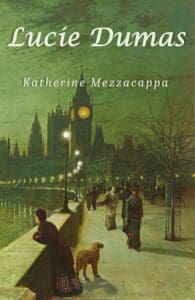
Lucie Dumas
by Katherine Mezzacappa
Blurb:
London, 1871: Lucie Dumas of Lyon has accepted a stipend from her former lover and his wife, on condition that she never returns to France; she will never see her young son again. As the money proves inadequate, Lucie turns to prostitution to live, joining the ranks of countless girls from continental Europe who’d come to London in the hope of work in domestic service.
Escaping a Covent Garden brothel for a Magdalen penitentiary, Lucie finds only another form of incarceration and thus descends to the streets, where she is picked up by the author Samuel Butler, who sets her up in her own establishment and visits her once a week for the next two decades. But for many years she does not even know his name. Based on true events.
Any Triggers: This is the story of a 19c prostitute and her attempts to escape the streets, but it is not in any sense explicit. There is some reference to the physical effects of syphilis, a rape (but not in detail, simply that it happened) and to a client’s proclivity for physical punishment. The book is quite definitely does not take the form of a ‘tell all’ memoir. It’s a story of survival at a time when ‘fallen’ women were urged to mend their ways but left with precious few avenues by which to achieve this.
Buy Link:
Universal Buy Link: https://books2read.com/u/m0yz0V
AUTHOR BIO: KATHERINE MEZZACAPPA

Katherine Mezzacappa is Irish but currently lives in Carrara, between the Apuan Alps and the Tyrrhenian Sea. She wrote The Ballad of Mary Kearney (Histria) and The Maiden of Florence (Fairlight) under her own name, as well as four historical novels (2020-2023) with Zaffre, writing as Katie Hutton. She also has three contemporary novels with Romaunce Books, under the pen name Kate Zarrelli. The Maiden of Florence was shortlisted for the Historical Writers’ Association Gold Crown award in 2025 and has also been published in Italian.
Katherine’s short fiction has been published in journals worldwide. She has in addition published academically in the field of 19th century ephemeral illustrated fiction, and in management theory. She has been awarded competitive residencies by the Irish Writers Centre, the Danish Centre for Writers and Translators and (to come) the Latvian Writers House.
Katherine also works as a manuscript assessor and as a reader and judge for an international short story and novel competition. She has in the past been a management consultant, translator, museum curator, library assistant, lecturer in History of Art, sewing machinist and geriatric care assistant. In her spare time she volunteers with a second-hand book charity of which she is a founder member.
She is a member of the Society of Authors, the Historical Novel Society, the Irish Writers Centre, the Irish Writers Union, Irish PEN / PEN na hÉireann and the Romantic Novelists Association, and reviews for the Historical Novel Review. She is lead organiser for the Historical Novel Society 2026 Conference in Maynooth, Co. Kildare.
Katherine has a first degree in History of Art from UEA, an M.Litt. in Eng. Lit. from Durham and a Masters in Creative Writing from Canterbury Christ Church.
Author Links:
Website: https://katherinemezzacappa.com/
Facebook: https://www.facebook.com/katherinemezzacappafiction/
Instagram: https://www.instagram.com/katmezzacappa/
Bluesky: https://bsky.app/profile/katmezzacappa.bsky.social
Amazon Author Page: https://www.amazon.co.uk/stores/Katherine-Mezzacappa/author/B0B8KJQ7GQ
Goodreads: https://www.goodreads.com/author/show/22717547.Katherine_Mezzacappa
GUEST POST: KATHERINE MEZZACAPPA
It’s a pleasure to be on your blog again, Linnea, this time with my new book Lucie Dumas.
Settings are really important to me when I am writing a historical novel. Quite often a place will inspire me to write a particular novel – it can be like a lightbulb moment – even if (as has happened) I don’t set the novel in the exact same place; it’s more that the place sets off a chain of thought.
With Lucie Dumas it was something I read, not something I saw, which set me writing this novel. But, once the idea is there, the setting follows. In a real sense, London is a character in the novel. It is inevitably though a London that is markedly different from its present appearance, and not just because of the Blitz. Developers need to take their share of blame too. So I used old maps, engravings and photographs (Philip Davies’s Lost London 1870-1945, published by English Heritage is a book of photographs I can get lost in for hours). Documentary evidence also tells you a lot about settings. For instance, the census for 7 Handel Street, Bloomsbury, lists besides Lucie Dumas herself (by then calling herself Dewattines), a carman, a coster-general dealer, a journalist, a baker, a watchmaker, a clerk, a foreman in a dining-room, a laundress, and the families of these breadwinners. So that address was teeming with people probably from the attics to the basement. How much did any of these people know about Lucie’s gentleman callers? Lucie herself told a fib to the census taker, describing herself as a ‘widow living on her own means.’ Lucie contracted tuberculosis, for which there was really no known cure, other than alleviating the illness by getting the patient into fresh, preferably salty air (which is why so many sanatoriums were built by the sea). I found a tuberculosis map not of London, but of Edinburgh, which makes it clear that tuberculosis (or consumption, as it was then often known as) is a disease of poverty and overcrowding. The teeming Royal Mile of Edinburgh is a rash of red spots, indicating a concentration of the disease, whereas in the spacious and affluent New Town and the southern suburbs, there are far fewer cases. The port of Leith was a crowded, working-class area, like the Royal Mile, but its seaside position meant that fewer suffered from tuberculosis. So with a disease that contagious, it was imperative that Lucie left her crowded Bloomsbury address. The man of letters Samuel Butler, chief of her gentleman callers, paid Lucie’s bills at the French Hospital (later transferred to Brighton, where the Medical Director was Dr Louis Vintras, who appears in the book as the translator of Lucie’s account of her life). He was chief mourner at her funeral at St Mary’s Catholic Cemetery, Kensal Green. The group with the priest at the graveside was a small one: Lucie’s brother, Butler, Henry Festing Jones (Butler’s friend and another ‘gentleman caller’) and Butler’s manservant Alfred Cathie.
The London Lucie Dumas knew was not strictly speaking Dickensian, as Dickens had died in 1870 and London was already benefitting from technological advances, like Bazalgette’s sewage system (begun 1859). For the cover of the novel I wanted something that captured the spirit of late Victorian London and when I saw John Atkinson Grimshaw’s ‘Reflections on the Thames’ I knew I had it. The painting wraps around the book perfectly and the lone figure of the pensive woman looking out across the river is just right. Reproduction rights to the picture are held by Bridgeman Images. Any historical novelist looking for the right cover could do worse than look at paintings of the period, as sometimes paying for the right to reproduce can be cheaper than commissioning a new one.
CLIFFORD’S INN
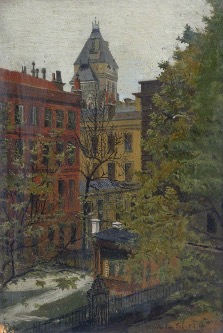
Clifford’s Inn, Fleet Street (since demolished); Samuel Butler lived in no. 15 Painting by Henry Festing Jones. Wikimedia Commons: St John’s College, Cambridge
THE FORMER FRENCH HOSPITAL
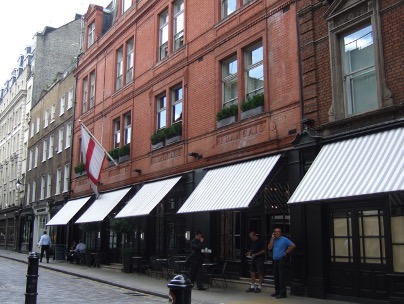
The former French Hospital, Shaftesbury Avenue, where Lucie Dumas died. Wikimedia Commons: Ceridwen
FRENCH CONVALESCENT HOME
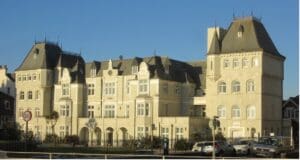
The former French Convalescent Home, Hassocks (near Brighton), where Louis Vintras was Medical Director. Wikimedia Commons: 5489
REFLECTION ON THE THAMES
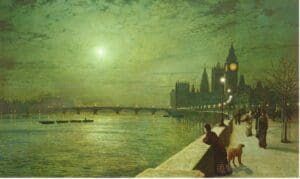
Reflections on the Thames, Westminster John Atkinson Grimshaw, 1880 Leeds Museums and Art Galleries. By permission of Bridgeman Images
 Twitter: @cathiedunn
Instagram & Threads: @thecoffeepotbookclub
Bluesky: @cathiedunn.bsky.social






Cathie Dunn
Posted at 08:12h, 28 AprilThank you so much for hosting Katherine Mezzacappa on your lovely blog today, sharing a fascinating article linked to her evocative novel, Lucie Dumas. We appreciate your support.
Take care,
Cathie xo
The Coffee Pot Book Club
Linnea Tanner
Posted at 22:00h, 29 AprilHi Cathie–It was my pleasure to host Katherine Mezzacappa and share her insight into writing “Lucie Dumas.”