
27 Oct Rosemary Griggs Mistress of Dartington Hall #HistoricalFiction #WomenInHistory #Elizabethan #SpanishArmada #BlogTour #TheCoffeePotBookClub @RAGriggsauthor @cathiedunn
FEATURED AUTHOR: ROSEMARY GRIGGS
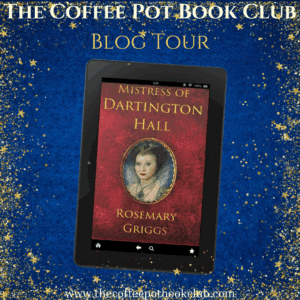
I’m delighted to host Rosemary Griggs again as the featured author in The Coffee Pot Book Club Blog Tour being held between October 20th – 31st, 2025. Rosemary Griggs is the author of the Historical Fiction / Women’s Fiction / Historical Biographical Fiction, Mistress of Dartington Hall (Book 3 – Daughters of Devon), published by Troubador Publishing on July 10th, 2025 (292 pages).
Below are highlights of Mistress of Dartington Hall, the author bio of Rosemary Griggs, and her guest post about researching Roberda for the book
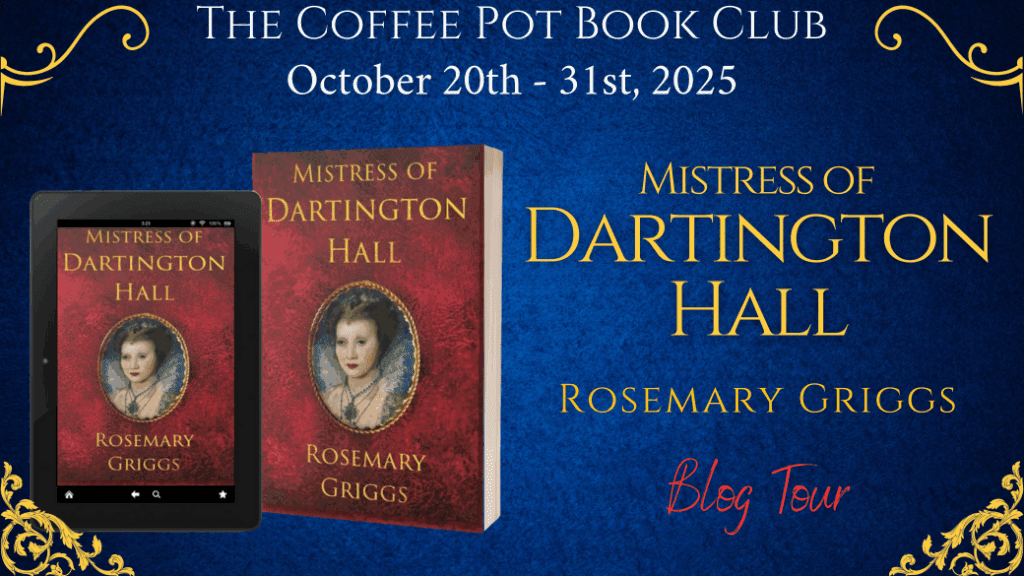 Tour Schedule Page: https://thecoffeepotbookclub.blogspot.com/2025/09/blog-tour-mistress-of-dartington-hall-by-rosemary-griggs.html
HIGHLIGHTS: MISTRESS OF DARTINGTON HALL
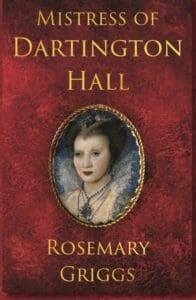
Mistress of Dartington Hall
(Book 3 – Daughters of Devon)
By Rosemary Griggs
Blurb:
England is at war with Spain. The people of Devon wait in terror for King Philip of Spain’s mighty armada to unleash untold devastation on their land.
Roberda, daughter of a French Huguenot leader, has been managing the Dartington estate in her estranged husband Gawen’s absence. She has gained the respect of the staff and tenants who now look to her to lead them through these dark times.
Gawen’s unexpected return from Ireland, where he has been serving Queen Elizabeth, throws her world into turmoil. He joins the men of the west country, including his cousin, Sir Walter Raleigh, and his friend Sir Francis Drake, as they prepare to repel a Spanish invasion. Amidst musters and alarms, determined and resourceful Roberda rallies the women of Dartington. But, after their earlier differences, can she trust Gawen? Or should she heed the advice of her faithful French maid, Clotilde?
Later Roberda will have to fight if she is to remain Mistress of Dartington Hall, and secure her children’s inheritance. Can she ever truly find fulfilment for herself?
Buy Link:
Universal Buy Link: https://books2read.com/u/4jjOZk
AUTHOR BIO: ROSEMARY GRIGGS
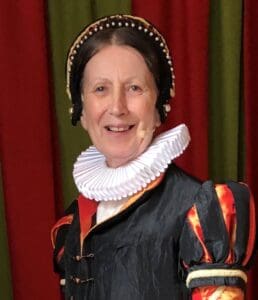
Author and speaker Rosemary Griggs has been researching Devon’s sixteenth-century history for years. She has discovered a cast of fascinating characters and an intriguing network of families whose influence stretched far beyond the West Country. She loves telling the stories of the forgotten women of history — the women beyond the royal court; wives, sisters, daughters and mothers who played their part during those tumultuous Tudor years: the Daughters of Devon.
Her novel, A Woman of Noble Wit, set in Tudor Devon, is the story of the life of Katherine Champernowne, Sir Walter Raleigh’s mother. The Dartington Bride, follows Lady Gabrielle Roberda Montgomery, a young Huguenot noblewoman, as she travels from war-torn France to Elizabethan England to marry into the prominent Champernowne family. Mistress of Dartington Hall, set in the time of the Spanish Armada, continues Roberda’s story.
Rosemary is currently working on her first work of non-fiction — a biography of Kate Astley, childhood governess to Queen Elizabeth I, due for publication in 2026.
Rosemary creates and wears sixteenth-century clothing, and brings the past to life through a unique blend of theatre, history and re-enactment at events all over the West Country. Out of costume, Rosemary leads heritage tours at Dartington Hall, a fourteenth-century manor house that was home of the Champernowne family for 366 years.
Author Links:
Website Twitter / X Facebook Instagram Threads
Bluesky Amazon Author Page Goodreads
GUEST POST: RESEARCHING ROBERDA
Years of research into the Champernowne family, extensive reading and study of Tudor history underpin my Daughters of Devon novels. I love delving into the archives and poring over ancient papers and parchments as I piece together the lives of the women of Tudor Devon. Uncovering the details of Lady Gabrielle Roberta Montgomery’s life has been fascinating.
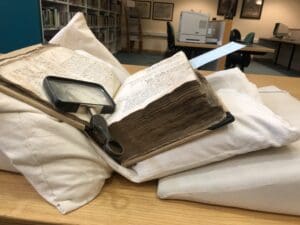
Searching for details in the Devon Archives South West Heritage Trust
I always begin with the few surviving original source documents that refer directly to my subject. Then I spread the net wider and search for family members, parents, husband, children and beyond. I soon discovered that Roberda’s father played an important part in her story. Among the sources I consulted in search of Gabriel de Lorges, Comte de Montgomery, were some interesting texts written in French — notably ‘Montgomery, le regicide’ by Alain Landurant. I had to resort to Google Translate when my schoolgirl French proved inadequate.
Roberda grew up in France during the Wars of Religion. In 1559, her father, Gabriel de Lorges, later Comte de Montgomery, killed the king of France in a jousting accident. He then converted to the Protestant faith and became a prominent Huguenot general in the French Wars of Religion.
When I began my research, I knew little about that period in French history. In England in the sixteenth century, we escaped outright warfare over religion. Discovering the tumultuous events unfolding on the other side of the English Channel, in which Roberda’s family played a leading part, was quite an eye-opener. The French Wars of Religion lasted 36 years, from 1562 to 1598.
There were eight separate conflicts between French Catholics and Protestants (Huguenots), interspersed with periods of uneasy peace. The bloodshed and persecution of the Huguenots was appalling, particularly after the St. Bartholomew’s Day massacre in 1572, which Roberda’s family only narrowly escaped. The letters of the French ambassador to England, Bertrand de Salignac de La Mothe-Fénelon, to the King of France helped me unpick the story of that tragic day in Paris. For example, on 2 October 1572 he wrote that Gabriel had escaped and come secretly to Sir Arthur Champernwone’s house.
William A. Heap’s book, Elizabeth’s French Wars, gave me a lot of useful background detail about how Queen Elizabeth of England sporadically supported the Huguenot cause. Having tracked Roberda’s family through the Wars of Religion, I discovered copious papers relating to her marriage in the records of the Exeter Church Consistory Court.
My initial research yielded the fixed milestones in Roberda’s life, a series of events we know she or members of her family were involved in. To weave her story around those events, I needed to understand the times she lived through, the wider political and social context, and the locations in my story.
I embarked on countless hours of desk research. The internet is rather wonderful, but I always double-check every reference. I did a lot of reading, and I visited places Roberda knew, including Mells and Cloford in Somerset. I undertook some detailed investigations at Dartington Hall to establish the layout during Sir Arthur Champernowne’s time.
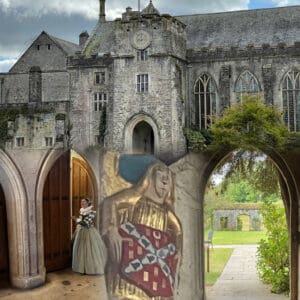
Dartington Hall, Devon, England.
I drew heavily on this research for The Dartington Bride, which covers the Roberda’s early life. To continue Roberda’s story in Mistress of Dartington Hall, I expanded on my previous work, focusing on the era of the Spanish Armada.
We join Roberda in the autumn of 1587. She’s been managing the family estate while her estranged husband, Gawen, has been in Ireland on the Queen’s business. England and Spain had been at war for over two years. Rumours swirled that the Spanish king was building the biggest war fleet ever. Everyone expected they’d try to land first at Falmouth, Plymouth, or Dartmouth, hoping to gain a foothold in England. Thousands of Spanish soldiers would then come ashore and wreak havoc. It must have been a frightening time for the people of Dartington, just sixteen miles upriver from Dartmouth. Unsurprisingly, I uncovered records of several false alarms.
John Roberts’ Devon and the Spanish Armada gave me a wealth of detail specific to Devon, and directed me to other sources. It was easy to discover naval battles, chains of warning beacons, and the roles of the Deputy Lieutenants. England had no standing army, but I learned about musters of poorly equipped and inadequately trained men who would be the first line of defence against the Spaniards.
Finding out what ordinary people were doing proved more difficult. However, the Dartington churchwarden’s accounts gave me helpful clues. In the main, these accounts record income from renting out church lands and minor items of expenditure. In most years I found payments for things like digging graves, cleaning the church, replacing bell ropes, mending the church gate, or providing bread and drink for the bell-ringers. However, in 1587 and 1588, other, more warlike items appear. I found records of payments for polishing the parish armour, purchase of muskets, bows and arrows, four swords and a dagger, and powder and match to serve with a caliver (a lightweight, 16th-century musket or arquebus). I traced the preparations the parish made to go to war, including making bullets, and paying the men who joined Sir John Gilbert, Deputy Lieutenant of the county, on Warborough Common, ready to repel the invaders. In the end, they merely watched as the Spanish fleet sailed by in July 1588.
While the churchwarden’s accounts helped me to understand how the ordinary men of Dartington prepared to go to war, I found no records to tell me what the women did. In wartime, women often step beyond traditional gender barriers. I looked for similar situations throughout history where women stepped up to the plate. I took inspiration from the women who, during the American Civil War, gathered essential supplies for soldiers, including clothing, food, and medical supplies. I researched how English women volunteered as nurses and ambulance drivers, and worked in munitions factories during the First World War. I read about the women who joined the Land Army, and those who stayed at home and ‘Dug For Victory’ during the Second World War.
Providing supplies of food, clothing and medicines for the men mustered to fight against the invaders seemed a likely way Roberda might have made her contribution to the war effort in 1587/88. All parishes kept a few items of often outdated armour safely stored in the church against the need to muster. A few lucky men would wear the parish armour; others would have to make shift for themselves. Woollen or leather jerkins would give scant protection. A jack o’plates — a padded jerkin with pieces of metal stitched in — would be much more effective. I needed to know whether women could successfully make such garments.
After reading as much as I could find, I studied a surviving Jack o’plates at Warwick Castle.
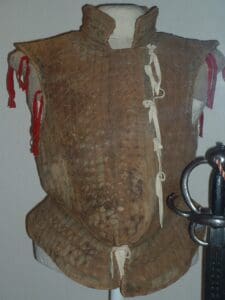
Jack o’plates on display at Warwick Castle
I also checked out the details of another at the Royal Armouries in Leeds. I could see how layers of linen, canvas and padding could form a sandwich around small iron plates. My research revealed that sometimes they cut up outdated suits of armour to provide the metal plates. I could have the Dartington Blacksmith do that. But could women construct such a garment? So next, I had to try some experimental archaeology. I didn’t make an entire padded jerkin, but, after a struggle, I pushed a large needle through the toughest canvas I could get my hands on. The experiment convinced me it would be possible for the women of Dartington to sew a jack o’plates, but only with the right tools. In my story Roberda seeks advice from a sailmaker, who supplies strong sailmaker’s needles.
The war between England and Spain persisted for another 16 years. An attempted counter-armada by the English in 1589 ended in failure. Philip of Spain attempted twice more to invade. The rest of Roberda’s life played out against a background of constant fear that the Spanish might come. Roberda and the women of Dartington played their part, but Gawen’s return brought a lot of tension into Roberda’s life. She faced many other challenges as Mistress of Dartington Hall.
 Twitter: @cathiedunn
Instagram & Threads: @thecoffeepotbookclub
Bluesky: @cathiedunn.bsky.social






Cathie Dunn
Posted at 09:24h, 28 OctoberThank you so much for hosting Rosemary Griggs today, with such an interesting article about her research for her compelling new novel, Mistress of Dartington Hall.
Take care,
Cathie xo
The Coffee Pot Book Club
Linnea Tanner
Posted at 16:12h, 30 OctoberHi Cathie–It was my pleasure to host Rosemary Griggs. I also found the efforts she put into the historical backdrop of Dartington Hall fascinating.