

02 Oct Stephanie Cowell The Man in the Stone Cottage #Brontë #Yorkshire #Victorian #EnglishLiterature #WomenWriters #HistoricalFiction #TheCoffeePotBookClub #BlogTour
FEATURED AUTHOR: STEPHANIE COWELL
I’m delighted to host Stephanie Cowell as the featured author in The Coffee Pot Book Club Blog Tour being held between September 22nd – October 3rd, 2025. Stephanie Cowell is the author of the historical fiction, The Man in the Stone Cottage: A novel of the Brontë Sisters, published by Regal House Publishing on September 16th, 2025 (258 pages).
Below are highlights of The Man in the Stone Cottage, Stephanie Cowell’s author bio, and the author’s guest post about the historical background of the novel.
Tour Schedule Page: https://thecoffeepotbookclub.blogspot.com/2025/08/blog-tour-the-man-in-the-stone-cottage-by-stephanie-cowell.html
HIGHLIGHTS: THE MAN IN THE STONE COTTAGE
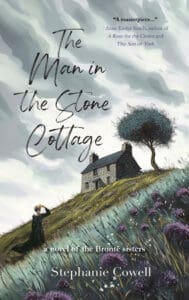
The Man in the Stone Cottage: A novel of the Brontë Sisters
By Stephanie Cowell
Audiobook by Brilliance Audio
Blurb:
“A haunting and atmospheric historical novel.” – Library Journal
In 1846 Yorkshire, the Brontë sisters— Charlotte, Anne, and Emily— navigate precarious lives marked by heartbreak and struggle.
Charlotte faces rejection from the man she loves, while their blind father and troubled brother add to their burdens. Despite their immense talent, no one will publish their poetry or novels.
Amidst this turmoil, Emily encounters a charming shepherd during her solitary walks on the moors, yet he remains unseen by anyone else.
After Emily’ s untimely death, Charlotte— now a successful author with Jane Eyre— stumbles upon hidden letters and a mysterious map. As she stands on the brink of her own marriage, Charlotte is determined to uncover the truth about her sister’ s secret relationship.
The Man in the Stone Cottage is a poignant exploration of sisterly bonds and the complexities of perception, asking whether what feels real to one person can truly be real to another.
Praise for The Man in the Stone Cottage:
“A mesmerizing and heartrending novel of sisterhood, love, and loss in Victorian England.” – Heather Webb, USA Today bestselling author of Queens of London
“Stephanie Cowell has written a masterpiece.” – Anne Easter Smith, author of This Son of York
“With The Man in the Stone Cottage, Stephanie Cowell asks what is real and what is imagined and then masterfully guides her readers on a journey of deciding for themselves.” – Cathy Marie Buchanan, author of The Painted Girls
“The Brontës come alive in this beautiful, poignant, elegant and so very readable tale. Just exquisite.” – NYT bestseller, M.J. Rose
“Cowell’s ability to take readers to time and place is truly wonderful and absorbing.” – Stephanie H. (Netgalley)
“Such a lovely, lovely book!” – Books by Dorothea (Netgalley)
Buy Link:
Universal Buy Link: https://books2read.com/u/mqLV2d
AUTHOR BIO: STEPHANIE COWELL

Stephanie Cowell has been an opera singer, balladeer, founder of Strawberry Opera and other arts venues including a Renaissance festival in NYC.
She is the author of seven novels including Marrying Mozart, Claude & Camille: a novel of Monet, The Boy in the Rain and The Man in the Stone Cottage. Her work has been translated into several languages and adapted into an opera. Stephanie is the recipient of an American Book Award.
Author Links:
Website: https://stephaniecowell.com
Facebook: https://www.facebook.com/stephanie.cowell.14
Instagram: https://www.instagram.com/cowell.stephanie/
Amazon Author Page: https://www.amazon.com/author/stephaniecowell
Goodreads: https://www.goodreads.com/author/show/197596.Stephanie_Cowell
HISTORICAL BACKGROUND: THE MAN IN THE STONE COTTAGE
“The Victorian Era in Britain,” read one article I found, “was dominated by the reign of Queen Victoria (1837-1901). Although it was a peaceful and prosperous time, there were still issues within the social structure.” Oh, there certainly were issues! During Victoria’s time a worldwide empire was built, with unprecedented expansion of its overseas landholdings. It was also a period of achievement in science, industry and the arts. And many people were crushed and lost under the laws.
My novel – The Man in the Stone Cottage – is about the three literary Brontë sisters in 1844-1848 in the time when they were writing their great novels. How would the wars and colonization and economics of their times have affected the little family of the Reverend Patrick Brontë and his three daughters Charlotte, Emily, Anne and son Branwell? Well, the industrial age had descended on their small village of Haworth, Yorkshire with factories just outside the town which polluted their water, already tainted with disease, running as it did under the graveyard earth just outside their parsonage door. (Reverend Brontë suspected this but no one would believe him.) Every day, as the daughters walked through the small village, they were aware of the lack of opportunity for the poor and the dirt and rank odors around them.
The little family in their clean parsonage home on the hilltop held serious discussions of politics and social problems around the dinner table. One of the worse problems was the Irish Famine which reached its height in 1847, in the same year that Jane Eyre and Wuthering Heights were published. Surely Patrick Brontë who was Irish and had been born there had relatives and friends in distress who were among the million who died! Surely, the family grieved, terrified by the silences of those perhaps lost. Penny postage letters might have found no one in a deserted Irish cottage.
At that time, England was also divided by social classes. Upper classes were divided into three subcategories: Royal, those who came from a royal family, Middle Upper, important officers and lords, and Lower Upper, wealthy men and business owners. The wealthiest build or owned great house with many servants to serve them. Middle class, ever growing, owned small businesses and allowed the women to dress beautifully but not as beautifully as the wealthy.
The Brontë sisters, as highly educated daughters of a clergyman, fell into a rarified class that no one knew how to label: they were teachers and governesses, albeit the only paid work an educated woman could have. When employed by a great house, they could not socialize with the servants, nor could they socialize with their employers. Money divided them. It was lonely to be a governess. That Jane Eyre marries her wealthy employer is a lovely story but not a likely one. (It was not until 1860 that the career of a nurse opened to qualified women and women would get the vote in a limited way in 1918).
One of the greatest problems of the era in which the three Brontë girls wrote their novels was the poverty around them of the lower class: the huge mass of the poor. They were the working poor who sometimes could only feed their family bread and dripping) and not those who had fallen to the bottom and had not four pence for a bed for a night or a half penny for bread. Those were in dire straits.
One writer who addressed these issues was Charles Dickens who in private life fought intensely to help the poor. In1843, three years before Charlotte, Emily and Anne published their famous novels, he published A Christmas Carol which urged compassionate help. Victorian England’s social safety net was primarily the Poor Law of 1834, which centralized aid in workhouses which provided basic sustenance and shelter but imposed harsh conditions to discourage reliance on public assistance. A gentleman says to Scrooge in A Christmas Carol, “Many can’t go there; and many would rather die.” To which Scrooge famously replies, “If they would rather die, they had better do it and decrease the surplus population.”
If you were very poor, you could bring in a few pathetic shillings a week by sending your child to work. Unfortunately, Parliament had put in place child labor laws. England’s primary law regulating child mine labor was the Mines and Collieries Act of 1842, which prohibited the underground employment of any child under 10 years old and no female workers at all. This legislation aimed to protect children from the hazardous work and harsh conditions prevalent in coal mines. So, by law, your ten-year-old son could spend fourteen hours a day in a dark mine but your nine-years old could waste his time at home unemployed.
And then there were the rights of women! What rights? Charlotte, Emily and Anne Brontë were quite aware of the limited agency of married women. The husband had complete control of the family finances and her personal property, her earnings, and even her children belonged to him. Even when a husband abandoned his wife, he retained control of her property. So when Anne Brontë published her novel The Tenant of Wildfell Hall, in which the wife flees from her drunken, lustful, wretched husband, her older sister Charlotte found the subject so shocking that, after Anne’s death, she suppressed a second printing for ten years.
But lovely news! This period was of course that of the expanded British empire which brought the products of the world to England. Charlotte and her sisters were aware that two hundred miles south, the great port of London welcomed thousands of foreign ships bringing exotic goods, some of which even made their way to their village of Haworth. Victorian England imported a wide range of products including raw materials like cotton, timber, and spices, as well as tea, coffee, and sugar. Other imports included silk, wines, and porcelain, particularly from India and China. When Charlotte began to earn good money from her novels, she had a few fine dresses made for herself. One which she wore to go on her honeymoon was shot silk, a fabric which is made up of silk woven from warp and weft yarns of two or more colors producing an iridescent appearance.
To tell the whole historical background of The Man in the Stone Cottage would take a heavy book indeed, so I have touched on a little bit of the history and laws and wealth and poverty pressing against the home and the imagination of the Brontë sisters and their brother a little more than 175 years ago in a dull little village on the Yorkshire moors which you can visit. Miraculously, almost nothing has changed from when the family lived there. You can travel back in time.
 Twitter: @cathiedunn
Instagram & Threads: @thecoffeepotbookclub
Bluesky: @cathiedunn.bsky.social






Cathie Dunn
Posted at 09:19h, 03 OctoberThank you so much for hosting Stephanie Cowell today, with such an interesting history post linked to her evocative new novel, The Man in the Stone Cottage.
Take care,
Cathie xo
The Coffee Pot Book Club
Linnea Tanner
Posted at 23:35h, 06 OctoberHi Cathie–It was a pleasure to feature Stephanie Cowell and her novel, “The Man in the Stone Cottage.”